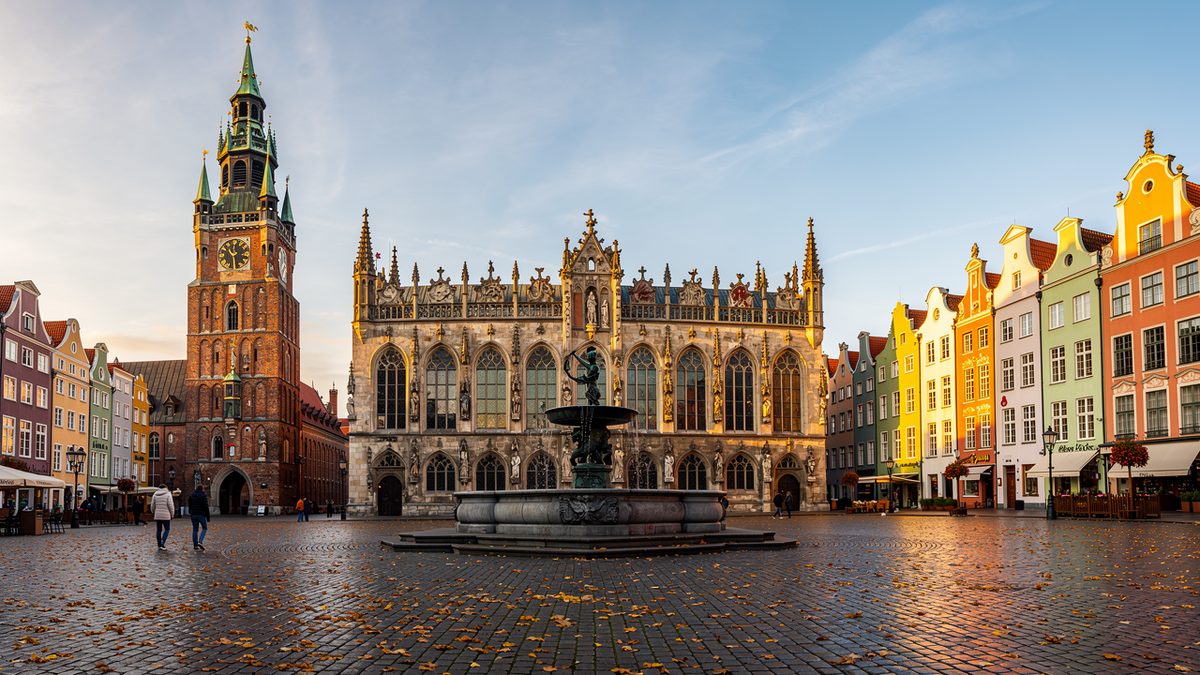
Stand in the middle of the Long Market and two buildings compete for your attention. On one side the Main Town Hall pushes its slim brick tower and gilded spire above every roof in the Main Town. On the other, behind the bronze Neptune, the tall windows of Artus Court show where Gdańsk's merchants once drank, argued and traded grain. Both are branches of the Museum of Gdańsk, both sit on the same street a minute apart, and both are free on Mondays. This guide covers the 2026 tickets and hours, what is worth seeing inside each, the closures you need to know about this autumn, and how to fit the two into one easy morning.
Key facts
| Main Town Hall | Ratusz Głównego Miasta, Długa 46/47, 80-831 Gdańsk; visitor entrance from Długa through the gate next to the front steps |
|---|---|
| Artus Court | Dwór Artusa, Długi Targ 43/44, 80-831 Gdańsk; opposite the Neptune Fountain |
| Hours (both) | Mon 10:00–16:00 (free entry), Tue closed, Wed 10:00–16:00, Thu 10:00–18:00, Fri–Sun 10:00–16:00; tickets sold until 45 minutes before closing |
| Tickets (each) | 26 zł standard, 19 zł reduced, family ticket 70 zł (1–2 adults with up to 6 children under 18) |
| Museum pass | 90-day pass for all Museum of Gdańsk branches: 160 zł, reduced 110 zł |
| Audio guide | 10 zł, in Polish, English or German, at both ticket desks |
| Visit length | Town Hall at least 45 minutes; Artus Court with the Gdańsk Hall at least 30 minutes |
| Town Hall tower | Closed for renovation (normally open in summer only, about 200 steps) |
| Partial closures | Town Hall: 5–20 Nov 2026 exhibition rooms I–III, the Kamlaria, the Depozyt, the Upper Hall and the Maritime Room closed; from 21 Nov the Maritime Room only, until further notice |
| Closed in 2026 | 1 and 6 January, 4–6 April, 4 June, 1 November, 24–26 December, 31 December; open on 11 November |
Key takeaways
- Do not plan either building for a Tuesday: every Museum of Gdańsk branch on the Royal Way is closed that day
- Monday is free in both, but on free days some temporary exhibitions may be unavailable and the rooms are busier
- Outside Thursdays the doors close at 16:00 and the ticket desk at 15:15, which is earlier than most visitors expect
- The Town Hall's viewing tower is shut for renovation, so for a view over the roofs use the tower of St Mary's Church instead
- In November 2026 a large part of the Town Hall's exhibition rooms is closed until the 20th; the Red Room and the main state rooms are the reason to go anyway
- If you plan to see four or more Museum of Gdańsk branches, compare the 160 zł 90-day pass with single tickets
In this guide
1. The Main Town Hall: what you are looking at
The Main Town Hall is the building where Gdańsk governed itself. It stands where Długa street opens out into the Long Market, and according to the Museum of Gdańsk it was the seat of the city authorities from the middle of the fourteenth century until 1921. The core of the building is Gothic, from the late Middle Ages, and the interiors you visit today were fitted out in the sixteenth and seventeenth centuries, at the height of the city's wealth from the Baltic grain trade.
From the street, the tower is the giveaway. It rises about 80 metres and ends in a slender Renaissance spire topped with a gilded figure of King Sigismund Augustus, a reminder that this German-speaking Hanseatic city chose to belong to the Polish Crown and did very well out of it. The tower also carries the first of Gdańsk's three carillons: on Saturdays at 12:05 the museum runs a half-hour carillon concert, and the bells are loud enough to fill the whole of the Long Market. Stand near the Neptune Fountain to hear it properly.
Like almost every building in the Main Town, the Town Hall burned in 1945 and was rebuilt after the war. A lot of the furnishings had been evacuated before the fighting, which is why the state rooms look so complete. The Palowa Gallery on the ground floor, a temporary exhibition hall, is the one part of the building that came through the war without serious damage. Its name comes from the old Pfahlkammer, the office where duty was charged on goods brought into Gdańsk by ship, and the museum notes that the cellars underneath hold the oldest traces of settlement found in the city, provisionally dated to the 930s.
2. Inside the Town Hall: the Red Room and the rest
The route takes you up through several floors on a lot of stairs, and the reason most people come is on the first floor. The Great Council Hall, better known as the Red Room, is one of the finest Renaissance interiors in Northern Europe. The walls are hung with red fabric, the carved and gilded ceiling is set with paintings, and in its centre is the Apotheosis of Gdańsk by Isaak van den Blocke, painted in 1608. It shows the city as a prosperous port under God's protection, with the Polish crown and its links to the Commonwealth worked into the allegory. Bring the audio guide or read the room cards: almost every panel carries a moral message aimed at the councillors who sat underneath it.
Next door, the Great Hall of the Wety, or White Room, is a large ceremonial room hung with portraits of Polish kings; the city still uses it for official occasions. Look for the room called the Great Christopher, with its vaulted ceiling and the Polish eagle held by angels, and the wrought-iron grille at the stairs in the entrance hall, which bears the Gdańsk coat of arms and the date 1683. The museum also points out that the building hides the oldest door in Gdańsk, cellars and concealed passages, so do not rush the lower floors.
Higher up, the permanent exhibition covers the history of the city, including a reconstructed Gdańsk street with tenement fronts, street lamps, a post box and a sentry box, which tends to hold children's attention longer than the paintings do. The Kamlaria, a white room with a chessboard floor, carved Gdańsk wardrobes and brass chandeliers, shows how a well-off household was furnished.
The Palowa Gallery on the ground floor runs temporary exhibitions. Your Town Hall ticket covers it; on its own it costs 11 zł (reduced 7 zł). In autumn 2026 the gallery is showing an exhibition about men from Gdańsk Pomerania conscripted into the German army in the Second World War, a difficult and very local subject. The gallery closes between exhibitions, so check the museum's events page if it is the part you came for.
The viewing platform at the top of the tower, normally open in summer only and reached by almost two hundred steps, is closed for renovation. For a roof-level view of the Main Town, our guide to the best viewpoints in Gdańsk covers the alternatives, and St Mary's Church, two streets away, has the tallest climb in the centre.
3. Artus Court: the merchants' hall
Artus Court is the building behind the Neptune Fountain with the tall arched windows and the statues on the roofline. The museum calls it the drawing room of old Gdańsk. It is first recorded in 1350, and over the centuries it served as the meeting house of the city's brotherhoods, a merchants' exchange and the place where the local elite entertained. From the middle of the eighteenth century until 1932 it housed the grain exchange. The building was destroyed in the Second World War and rebuilt afterwards.
The name comes from King Arthur. Medieval merchant brotherhoods across the Baltic, from Gdańsk to Toruń and Riga, named their halls after him because of the Round Table, a symbol of equals sitting together without a head of the table. Inside that idea is everywhere: the paintings and carvings, originals and careful reconstructions, draw on ancient myths and medieval legends, and the museum reads them as a call for tolerance and agreement in a divided Europe, made sometimes seriously and sometimes as a gentle joke.
What you see is essentially one great hall, and it is enough. Four slender granite columns hold up a palm-like vault, model ships hang on ropes between them, and the walls are lined with wood panelling, paintings and sculpture. In one corner stands the great tiled stove: 10.64 metres high and built of 520 decorated tiles, it is described by the museum as the largest tiled stove in Europe. Many of the tiles show rulers of the time, and it is worth a slow walk around it.
Your ticket also covers the Gdańsk Hall (Sień Gdańska) in the house next door, a reconstructed merchant's entrance hall with walls of blue and white tiles from Delft, a fireplace with a relief of the Gdańsk arms and a free-standing figure of Athena. It is small, and it gives you an idea of what the great houses along Długa looked like inside before 1945. For the full picture of a rich burgher's home, the museum's Uphagen House at Długa 12 is a separate branch at the same price.
Outside, the Neptune Fountain in front of Artus Court is free to look at around the clock. The bronze sea god was cast in 1615, and the fountain has been running since 1633. In the evening, when the Long Market is lit and the day groups have gone, it is one of the best spots in the city for photographs.
If you cannot walk long distances or are short on time, the Westerplatte and Old Town tour combines the Westerplatte peninsula with the Long Market, St Mary's and the Crane in 4 to 5 hours, with a private driver who collects you from your hotel. Because it is private, you can ask for an hour inside the Town Hall or Artus Court. (ShuttleHero is run by the same local team as Gdańsk Insider.)
4. Tickets, free Mondays and the 90-day pass
The Main Town Hall and Artus Court are priced the same: 26 zł standard and 19 zł reduced. Reduced tickets are for school pupils, students, retirees and pensioners with a valid ID card. A family ticket costs 70 zł and covers up to eight people, one or two adults with children under 18. The audio guide is 10 zł at either desk and comes in Polish, English and German.
There is no combined ticket for just these two buildings. Seeing both costs 52 zł per adult. If you also want the Amber Museum (37 zł), Uphagen House (26 zł) or the new Post Office Museum, look at the 90-day pass for all Museum of Gdańsk branches: 160 zł, reduced 110 zł. It pays off for a museum-heavy trip of four or five branches; for the Town Hall and Artus Court alone it does not. Our Gdańsk museums guide lists all branches with prices and free days.
Entry to both buildings is free on Mondays, during the normal 10:00 to 16:00 hours. The museum warns that on free days some temporary exhibitions may be unavailable, and the rooms fill up with school groups and locals. If you can pay, a Wednesday or Friday morning at 10:00 is the calmest time. Artus Court states that it does not take ticket reservations, so simply buy at the desk when you arrive.
5. Opening hours, closures and the November works
Both buildings keep the same hours all year: Monday 10:00 to 16:00, closed Tuesday, Wednesday 10:00 to 16:00, Thursday 10:00 to 18:00, Friday to Sunday 10:00 to 16:00. The desk stops selling tickets 45 minutes before closing, so on most days the last sensible entry is about 15:00. Thursday is the long day, and the museum often holds curator tours, book launches and lectures in the Town Hall on Thursday evenings.
In 2026 the museum is closed on 1 and 6 January, 4 to 6 April (Easter), 4 June, 1 November (All Saints' Day), 24 to 26 December and 31 December. It is open on 11 November, Independence Day, which is useful because many other places close.
The Town Hall has works in progress this November. From 5 to 20 November 2026 exhibition rooms I to III, the Kamlaria, the Depozyt, the Upper Hall and the Maritime Room are closed to visitors. From 21 November only the Maritime Room stays closed, until further notice. The Red Room and the White Room are not on the closure list, but the visit is shorter than usual while the works last; if your trip falls in this window and the Town Hall is a priority, aim for the second half of the month. Artus Court is not affected. Uphagen House, the third branch on Długa, is closed from 30 November to 2 December.
From late November the Christmas market spreads along Długa and onto Targ Węglowy, a few steps from the Town Hall, so a December visit combines well with mulled wine and the lights on the Royal Way.
6. Accessibility, bags and photos
Main Town Hall: the building has hundreds of steps between floors. There is a lift for wheelchair users, entered from the back of the building at Piwna 35/37; the museum asks you to contact its accessibility coordinator two to three days in advance so it can prepare. The lift reaches every exhibition level but not the viewing tower. Three walking frames can be borrowed free of charge, one ticket desk has an induction loop, and lockers for bags are in the Palowa Gallery.
Artus Court: wheelchair users enter from Chlebnicka street, where staff put out a ramp. The museum says that visits in electric wheelchairs are not possible at the moment for technical reasons. There is a tactile graphic of the facade with audio description by the main entrance, and a Braille guide can be borrowed at the desk. The building has a cloakroom and lockers.
Photography without flash is allowed in both buildings. Photo sessions, for example wedding shoots, have to be booked with the museum five days ahead and cost 300 zł.
Arriving from the airport? The Long Market is about 15 km by road from the terminal. Our airport to city centre guide compares the train, bus, taxi and private transfer. A fixed-price transfer to the Main Town costs €35 by car for 1 to 3 people and €45 by van for 4 to 8, with the price agreed when you book.
7. How to see both in one morning
The two buildings are about 60 metres apart, so seeing both is easy. A sequence that works on any day except Tuesday:
- 9:30 Walk the Royal Way from the Golden Gate down Długa while the street is still quiet. Uphagen House at Długa 12 is on the way if you want a third interior.
- 10:00 Main Town Hall as it opens. Red Room first, before the groups, then the White Room and the upper floors. About an hour with the audio guide.
- 11:15 Cross to Artus Court for the great hall, the stove and the Gdańsk Hall. 30 to 45 minutes.
- 12:00 Coffee on the Long Market, then the Green Gate and the Motława waterfront. On a Saturday, be outside the Town Hall at 12:05 for the carillon.
- Afternoon St Mary's Church, the Crane and the Maritime Museum, or the European Solidarity Centre, 15 minutes' walk north.
On a Monday, the same plan is free for both buildings, which makes it the best day for a budget trip; just expect company. If you only have one full day in the city, our one day in Gdańsk itinerary fits the Town Hall into a complete hour-by-hour plan.
To see the Long Market at its best, come back after dark. The facades, Neptune and the Town Hall tower are lit every evening, and the crowds thin out after 20:00. The Gdańsk by night tour does this as a 2 to 3 hour evening walk through the illuminated Old Town, with hotel pickup in Gdańsk, Sopot or Gdynia.
Prefer to do it all on foot? Everything in this guide is within a ten-minute walk of the Long Market, and our free things to do in Gdańsk guide fills the rest of a Monday without paying for a single ticket.
Frequently Asked Questions
How much is a ticket to the Main Town Hall in Gdańsk?
A standard ticket is 26 zł and a reduced ticket 19 zł. A family ticket for one or two adults with up to six children under 18 costs 70 zł. The audio guide in English, Polish or German is 10 zł. Entry is free on Mondays.
What are the opening hours of the Main Town Hall and Artus Court?
Both have the same hours: Monday 10:00 to 16:00 (free entry), closed on Tuesday, Wednesday 10:00 to 16:00, Thursday 10:00 to 18:00, and Friday to Sunday 10:00 to 16:00. Tickets are sold until 45 minutes before closing.
Is the Main Town Hall in Gdańsk free on Mondays?
Yes. Entry to the Main Town Hall, Artus Court and Uphagen House is free on Mondays from 10:00 to 16:00. On free days some temporary exhibitions may be unavailable and the rooms are busier.
Can you climb the Town Hall tower in Gdańsk?
Not at the moment. The Museum of Gdańsk states that the viewing tower is closed for renovation. When open it is a summer-only attraction of about 200 steps. For a view over the Main Town, climb the tower of St Mary's Church instead.
Is there a combined ticket for the Town Hall and Artus Court?
There is no ticket for just these two; each costs 26 zł, so both are 52 zł per adult. The 90-day pass for all Museum of Gdańsk branches costs 160 zł (reduced 110 zł) and is worth it if you plan four or more branches.
How long does it take to visit the Main Town Hall and Artus Court?
The museum recommends at least 45 minutes for the Main Town Hall and at least 30 minutes for Artus Court with the Gdańsk Hall. With an audio guide, plan about two hours for both. They are about 60 metres apart on the Long Market.
Are the Main Town Hall and Artus Court accessible for wheelchair users?
The Main Town Hall has a lift entered from Piwna 35/37 that reaches all exhibition levels but not the tower; contact the museum's accessibility coordinator two to three days ahead. Artus Court has a ramp at the Chlebnicka entrance, but visits in electric wheelchairs are currently not possible.