Gdańsk is a low city with a few very high things in it, which is exactly what makes it such a good place to look down on. The Main Town is a tight grid of gabled houses, and from almost any height the whole of it fits in a single frame: the town hall spire, the brick bulk of St Mary's, the Crane, the river bending past the granaries and, on a clear day, the shipyard cranes and the line of the Baltic beyond. The question is not whether to get up high but which way to do it, because each viewpoint shows you a different city. This guide covers the ones worth your time, what they cost in October 2026, and when each of them is at its best.
| St Mary's tower | 405 steps; 20 zł, reduced 10 zł; closes in storms |
|---|---|
| Best free view | Góra Gradowa, behind Gdańsk Główny station |
| After dark | AmberSky wheel 49 zł (reduced 39 zł); Olivia Star deck to 22:00 on weekdays |
| Olivia Star deck | 26 zł online, 29 zł at the desk; last ride up 1 h 20 min before closing |
| Town Hall tower | Summer only; town hall ticket 26 zł, Mondays free |
Key takeaways
- St Mary's tower is the classic: 405 steps, no lift, 20 zł standard and 10 zł reduced, closed in storms
- Góra Gradowa, ten minutes on foot from Gdańsk Główny, is free and shows the Main Town with St Mary's in it
- The town hall tower is summer only; the museum ticket is 26 zł and Monday entry is free
- AmberSky (49 zł, reduced 39 zł) and Olivia Star are the only elevated views after sunset
- Olivia Star, the tallest building in northern Poland, has a 32nd-floor deck over the whole Tri-City and the bay
- Pachołek Hill in Oliwa has a free tower over the park, the cathedral and the sea
- The best ground-level frames are free: the Green Bridge, Granary Island, the Mariacka Gate and Ołowianka
- Late afternoon light falls on the Long Market facades from the west; mornings belong to the river
In this guide
- Which viewpoint for which trip
- St Mary's tower: the classic climb
- The town hall tower, summer only
- Góra Gradowa: the best free view
- AmberSky: the view after dark
- Olivia Star: the whole Tri-City
- Ground-level frames along the Motława
- Pachołek Hill and the shipyard
- Beyond Gdańsk: Sopot, Gdynia and Kashubia
- Light, weather and season
- FAQ
1. Which viewpoint for which trip
Before the detail, the short version. Gdańsk's viewpoints fall into three groups, and most visitors only need one from each.
- The Main Town from inside it: St Mary's tower, or the town hall tower in summer. You are in the middle of the grid, looking straight down Long Market and along the roofs to the river. This is the view on the postcards.
- The Main Town from outside it: Góra Gradowa. You are on a hill to the west, looking at the whole skyline in profile, St Mary's included. This is the view the city's own photographers use, and it is free.
- The region: Olivia Star in Oliwa, or Pachołek Hill next door. You see Gdańsk, Sopot and Gdynia as one coastline, with the port and the bay, and you understand why locals talk about the Tri-City as one place.
If you only have one day, do St Mary's in the morning and Gradowa in the late afternoon. If you have 48 hours, add Oliwa on the second day, combined with the park and the organ in the cathedral. If you are here after dark, it is the wheel.
2. St Mary's tower: the classic climb
St Mary's Church is one of the largest brick churches in the world, and the tower is the obvious way up. It is also honest work: 405 steps on a narrow brick staircase, no lift, a few tight sections where people coming down have to squeeze past people going up. The reward is a platform near the top of the tower with an unobstructed view in every direction, straight down onto the copper and tile roofs of the Main Town, across to the town hall spire, and out over the Motława to Granary Island and the shipyard cranes.
The church sells the tower ticket as a donation brick, a cegiełka, at the desk inside: 20 zł standard, 10 zł reduced, with the money going to the upkeep of the basilica. Entry starts at 10:00 and the last climb is at closing time, which is 18:00 or 20:00 depending on the season, so check the basilica's visitor page before a late climb. The tower closes during storms and bad weather, and in a strong wind the top is cold and noisy even in July, so bring a layer.
Two pieces of timing make the difference. First, go early or late: in July and August the queue on the staircase is the slow part, not the climb. Second, if you can, combine it with the astronomical clock inside the church, which runs its figure show once a day at 11:57. Climb at 10:30, come down at 11:30, sit in the nave for the clock. That is the most efficient hour in the Main Town.
Who should skip it: anyone with knee or heart problems, anyone uncomfortable in narrow spaces, and families with toddlers who would need to be carried. Gradowa gives a comparable view without the staircase.
3. The town hall tower, summer only
The Main Town Hall on Long Market has a tower of around 80 metres, crowned by the gilded figure of King Sigismund Augustus, and its viewing gallery puts you right above the main street. It is a slightly lower and more central view than St Mary's, with the advantage that you look back at St Mary's rather than standing on it.
The catch is that the Museum of Gdańsk opens the tower in summer only. From autumn to spring you get the interiors, including the Red Room, one of the finest Renaissance council chambers in northern Europe, but not the climb. The town hall ticket is 26 zł standard, 19 zł reduced, a family ticket for two adults and up to six children is 70 zł, and Monday entry to the town hall is free between 10:00 and 16:00. In season, check the museum's website for the tower slot before you plan around it, and do not assume the free Monday includes the tower.
If you are only doing one tower in summer, the rule of thumb is simple: St Mary's for the bigger view, the town hall for the better photograph of St Mary's.
4. Góra Gradowa: the best free view
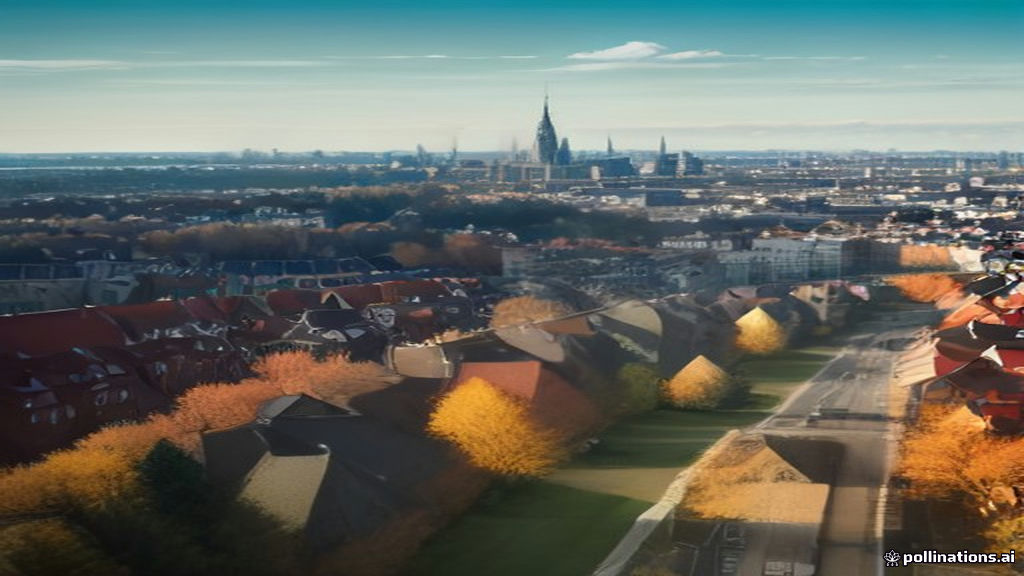
Ask a Gdańsk photographer where to shoot the skyline and the answer is usually Gradowa. The hill rises directly behind Gdańsk Główny, the main railway station, and was fortified for centuries, which is why the top is a maze of brick bastions, earthworks and tunnels now partly occupied by the Hevelianum science centre. The large white cross on the summit, the Millennium Cross, is visible from much of the city, which is also how you find the path up.
From the station, walk north along the tracks and take the steps and footpaths up the slope; it is about ten minutes and steep in parts. The Hevelianum itself names two viewpoints: the area around the Millennium Cross on the Jerusalem Bastion, over 51 metres above sea level, and the Kurkowy wing, which it describes, with some justification, as the finest panorama of the Old and Main Town. From here you see the whole historic skyline in profile: St Mary's, the town hall spire, St Catherine's, the Crane and, beyond, the shipyard and the sea.
The hill and its paths are free. The Hevelianum's indoor exhibitions are ticketed and open Monday to Saturday, 10:00 to 18:00, closed on Sundays, and there is a restaurant on site if you want to sit with the view. Bring the camera in the late afternoon: the sun is then behind you and the brick of the Main Town turns orange. Gradowa is not somewhere to wander alone after dark, as the paths are poorly lit, but at golden hour it is the best free hour in the city.
5. AmberSky: the view after dark
The towers close well before sunset, which leaves the AmberSky wheel on Granary Island as the only elevated view of the illuminated Main Town. A standard ride is 49 zł, the reduced ticket for children under 1.40 m and visitors with disabilities is 39 zł, and children under three ride free. The cabins are enclosed, which makes it the one viewpoint that works in rain, wind and winter.
The view is lower and less dramatic than from the towers, but the angle is better than you would expect: you look straight across the river at the Crane and the waterfront houses of Długie Pobrzeże, with St Mary's behind. The half hour after sunset is the moment, when the floodlights are on and the sky still has some colour. In December that is around 16:00; in June, past 21:30. Our guide to Gdańsk at night builds a full evening around it.
6. Olivia Star: the whole Tri-City
Olivia Star in the Olivia Business Centre, on Grunwaldzka at the Oliwa end of the city, is the tallest building in northern Poland, and its 32nd floor is a public viewing floor. From up here Gdańsk stops being a historic centre and becomes what it actually is: a long coastal city, running from the port and the shipyard past Oliwa to Sopot and on to Gdynia, with the Bay of Gdańsk filling half the window and the Hel Peninsula a thin line on the horizon on clear days.
The ticket combines the viewing floor with the Olivia Garden, a tropical glasshouse with thousands of plants in the same complex: 29 zł at the box office or 26 zł online, reduced 20 zł or 18 zł. Hours are long and evening-friendly: Monday to Thursday 12:00 to 22:00, Friday 12:00 to 01:00, Saturday 11:00 to 23:00, Sunday 11:00 to 20:00, with the last ride up 1 hour 20 minutes before closing. That makes it the second option after dark, and the better one if you want city lights rather than floodlit gables.
Getting there takes about twenty minutes from the Main Town by tram along Grunwaldzka or by the SKM commuter train to Gdańsk Przymorze-Uniwersytet, then a short walk. It pairs naturally with Oliwa Park and the cathedral, fifteen minutes further north.
7. Ground-level frames along the Motława
Not every great view needs height. Some of the best images of Gdańsk are taken from a few metres above the water, and all of them are free.
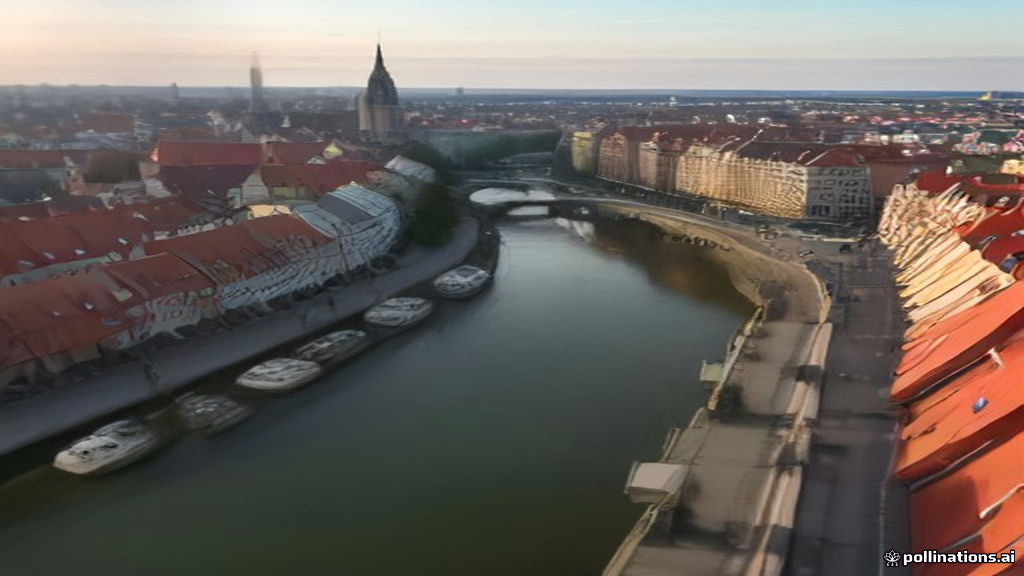
- The Green Bridge. Stand on the bridge just beyond the Green Gate, at the end of Long Market, and look north: the whole waterfront of Długie Pobrzeże runs away from you, with the Crane at the far end. At seven in the morning, before the boats and terraces, it is the purest view in the city.
- Granary Island. Cross to the island and look back. You get the waterfront head-on, including the facades that are hidden from the riverside walk itself, and the footbridge that swings open for boats.
- Ołowianka. The island opposite the Crane, home to the Maritime Museum's Soldek ship and the Philharmonic, gives the best straight-on view of the Crane, and it is quieter than the main quay.
- The Mariacka Gate. Walk down Mariacka Street towards the river and stop inside the gate: the arch frames the water and the granaries opposite. It works in any weather and at any hour.
- The view from the water. A boat to Westerplatte gives you the whole waterfront in sequence as you pull away from the quay, and then the port, the shipyard and the fortress at Wisłoujście.
Our Old Town walking tour threads most of these into a single route, so you can collect them without doubling back.
8. Pachołek Hill and the shipyard
Pachołek Hill, on the wooded ridge above Oliwa Park, is the local alternative to Olivia Star. A path climbs from the park through the beech woods to an observation tower at the top of a hill a little over a hundred metres high, free to climb. The view is the reverse of the Main Town panoramas: you look down on the twin towers of Oliwa Cathedral and the green of the park, then out over the city to the bay, with the port to the east and Sopot to the north. It is a fifteen-minute walk uphill from the cathedral, so combine it with a visit to the park and the famous organ. Our Oliwa guide has the times of the organ demonstrations.
The other modern viewpoint is in the former shipyard, north of the Old Town. The European Solidarity Centre has a roof terrace that looks out over the shipyard where the Solidarity strikes began in 1980: the historic gate, the giant cranes, the slipways and the new district growing between them. It is a different kind of view, industrial and unfinished, but it tells you more about modern Gdańsk than any church tower.
9. Beyond Gdańsk: Sopot, Gdynia and Kashubia
The Tri-City adds three more viewpoints that are worth the train ride.
Sopot pier is the longest wooden pier in Europe, at over 500 metres, and the view back from its end shows the beach, the Grand Hotel and the wooded hills behind the town. In season there is a small fee to walk onto it; out of season it is free and empty. The Sopot day trip guide has the details.
Kamienna Góra in Gdynia is a hill directly above the city centre, reached on foot or by a short funicular, with a view over the port, the Southern Pier with its museum ships and the whole curve of the bay. It is the best place to understand Gdynia, a city built in the 1920s and 1930s, as a single modernist plan. See our Gdynia guide.
Further afield, the Kashubian lake country southwest of Gdańsk is hilly in a way that surprises people who think of Poland as flat. The area around Wieżyca, the highest hill in the Kashubian lake country, is known as Kashubian Switzerland for its lakes and forested ridges, and the views over the lakes are the reason most people go. Our Kashubia day trip guide covers the route, and the private Kashubia tour costs from €40 per person in a group of eight (€100 each for two), with the driver only and any tickets paid on the spot.
10. Light, weather and season
Time of day. The Main Town's long axis runs roughly east to west, so the late afternoon sun lights up the facades of Long Market and the brick of St Mary's from the west. That is the time for the towers and for Gradowa. Mornings belong to the river, when the water is still and the quay is empty. Sunset itself is best from the wheel or from the bridges.
Sunset times. They swing more than visitors expect this far north: around 21:25 in late June, around 15:25 in late December. In winter, you can climb a tower at 14:00 and see the city lit up by 16:00. Our month-by-month guide has the detail.
Weather. The coast brings haze and sea fog, especially in spring and autumn, and a hazy day flattens the long views from Olivia Star and Pachołek. The towers and Gradowa are close enough to the Main Town to work in almost anything except heavy rain. Check the forecast for visibility, not just rain, before paying for the 32nd floor. If it does rain, the enclosed AmberSky cabins are the only view that still works, and our rainy day guide has the rest of the plan.
Season. The town hall tower is summer only, St Mary's stays open later in high summer, and the boats run April to October. Winter is the quietest time to climb, with no queue on the staircase, and the view of the snow on the roofs is something few visitors see. And in December the lit-up Christmas market weeks make the wheel and the Olivia Star deck at dusk better rides than they are in July.
Frequently Asked Questions
What is the best viewpoint in Gdańsk?
For the classic postcard, the tower of St Mary's Church: 405 steps to a platform above the roofs of the Main Town, 20 zł standard and 10 zł reduced. For a free view that is arguably better, because it includes St Mary's itself, walk up Góra Gradowa, the fortified hill behind the main railway station. For the whole Tri-City and the bay at once, take the lift to the 32nd-floor deck of Olivia Star in Oliwa.
How many steps are there up St Mary's tower in Gdańsk?
405, on a narrow brick staircase with no lift, which is one-way traffic in places, so expect to wait on landings when it is busy. Allow about an hour including the queue at the ticket desk inside the church. The tower closes in storms and bad weather, and the last entry is at closing time, so do not arrive five minutes before.
Is there a free viewpoint in Gdańsk?
Yes, several. Góra Gradowa, the hill with the large Millennium Cross above the main station, is free to walk at any time and gives the best panorama of the Old and Main Town. Pachołek Hill in Oliwa has a free observation tower over the park, the cathedral and the bay. And the riverside frames along the Motława, from the Green Bridge, Granary Island and the Mariacka Gate, cost nothing.
Can you see Gdańsk from above at night?
Only from two places. The church and town hall towers close before dark, so after sunset your options are the AmberSky wheel on Granary Island, 49 zł standard and 39 zł reduced, or the Olivia Star deck in Oliwa, which stays open until 22:00 on weekdays and later on Friday and Saturday. Góra Gradowa is technically open but poorly lit and not a comfortable walk alone after dark.
How much does the Olivia Star viewing deck cost?
A standard ticket covering the 32nd-floor viewing floor and the Olivia Garden is 29 zł at the box office or 26 zł online, with reduced tickets at 20 zł and 18 zł. It opens at 12:00 on weekdays and 11:00 at weekends, and the last ride up is 1 hour 20 minutes before closing, so check the clock before you set off.
Is the Main Town Hall tower open all year?
No. The Museum of Gdańsk opens the roughly 80-metre tower of the Main Town Hall in summer only, so from autumn to spring the town hall gives you the interiors but not the view. The museum ticket for the town hall is 26 zł standard and 19 zł reduced, and Monday entry to the town hall is free, though the free day does not guarantee tower access.
When is the best time of day for views in Gdańsk?
Late afternoon for the towers, when the low sun lights the gables of Long Market from the west and the Motława turns gold. Early morning for the riverside frames, before the tour boats and the terrace furniture appear. The half hour after sunset for the AmberSky wheel. Sunset runs from about 21:25 in late June to about 15:25 in late December, so plan the towers around the season.