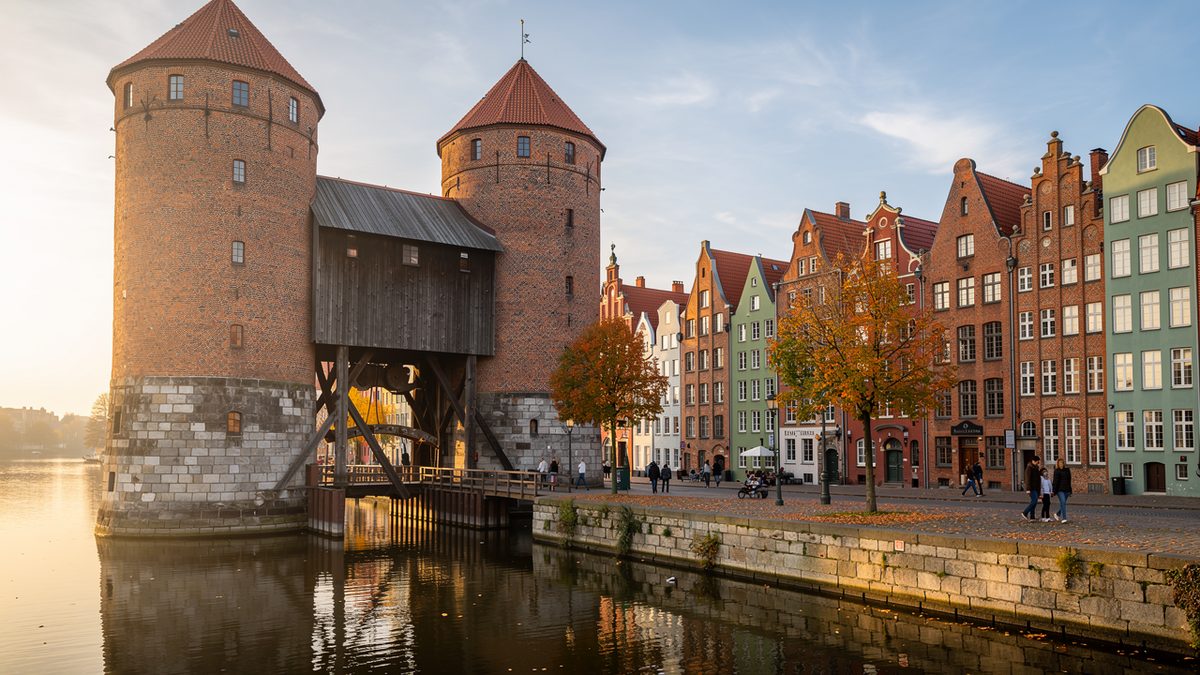
Every postcard of Gdańsk has it: a dark timber box hanging between two fat brick towers over the Motława. The Crane, Żuraw in Polish, is the symbol of the city's port, and since a three-year renovation finished in spring 2024 it is also one of the best small museums in the Main Town. Inside you climb through the towers, meet a seventeenth-century merchant as a hologram and finish next to the huge wooden wheels that men once walked to lift cargo. This guide covers the 2026 tickets and hours, the Monday and Wednesday traps, the passes that bundle the Crane with the National Maritime Museum and the Sołdek ship across the river, and how to fit it all into a day.
Key facts
| Name | Żuraw (the Crane), branch of the National Maritime Museum in Gdańsk (Narodowe Muzeum Morskie, NMM) |
|---|---|
| Address | ul. Szeroka 67/68, 80-835 Gdańsk; the river side faces Długie Pobrzeże (the Long Embankment) |
| Hours, 7 Sep–31 Dec 2026 | Tue 9:00–17:00, Wed 13:00–17:00, Thu–Sun 9:00–17:00; closed Mondays; last entry 60 minutes before closing |
| Hours in summer | 15 Jun–6 Sep 2026: Mon, Tue and Thu–Sun 10:00–18:00, Wed 13:00–18:00 |
| Tickets | 23 zł standard, 17 zł reduced; Wednesday free |
| Passes | Crane + Maritime Culture Centre 36/27 zł; Maritime Museum + Sołdek + Crane + Maritime Culture Centre 64/48 zł (82/60 zł with the interactive room) |
| Visit length | About 1 hour, exhibition on 3 floors; maximum 50 visitors inside at once |
| Accessibility | Not adapted for visitors with reduced mobility or for blind and partially sighted visitors |
| Closed in 2026 | 1 and 6 January, 5–6 April (Easter), 4 June, 1 November, 24–26 December |
Key takeaways
- The Crane is closed on Mondays from September to mid-January and from March to mid-June; it opens on Mondays only in late winter and in summer
- Wednesday is free, but the doors open only at 13:00 and only 50 people fit inside, so the free afternoon is also the busiest
- The ticket office closes an hour before the museum: in autumn, arrive by 16:00
- If you plan to see the main Maritime Museum and the Sołdek ship too, the 64 zł pass is cheaper than separate tickets (23 + 23 + 23 = 69 zł before the Culture Centre)
- The Crane has narrow stairs and no lift; the main museum building across the river does have one
- 1 November (All Saints' Day) is a closure day for every branch of the museum
In this guide
1. What the Crane is and why it matters
The Crane is a port crane and a city gate in one building. Two brick towers guard a passage from the waterfront into Szeroka street, and between them, high above the river, sits a wooden housing with the lifting gear. The form you see dates from the middle of the fifteenth century, and the National Maritime Museum describes it as the largest and oldest building of its kind in Europe. For several hundred years it lifted heavy cargo off ships and set up masts on new vessels, powered by nothing more than people walking inside giant wooden wheels.
That double job tells you a lot about medieval Gdańsk. The river was the city's main street. Grain from the Polish interior came down the Vistula on barges, was stored in the granaries on the islands opposite, and left for Amsterdam and the rest of Europe on sea-going ships. Luxury goods, wine, cloth and spices came the other way. The Crane stood at the centre of that trade, and controlling the water gate meant controlling who and what came into the city.
Like most of the Main Town, the Crane burned in March 1945 and was rebuilt after the war. The latest chapter is recent: between 2020 and 2024 the museum ran its largest restoration of the building in half a century, funded mostly by Iceland, Liechtenstein and Norway through the EEA Grants. The brick walls, roof and timber structure were repaired, the interiors of both towers were rebuilt, and spaces that had been closed to visitors were opened up. The project was formally completed on 29 April 2024, and the museum reported more than 22,000 visitors in the first three months after reopening. If you last saw the Crane before 2021, it is a different visit now.
2. Inside: the "Gold for Grain" exhibition
The new permanent exhibition is called "Złoto za zboże. Morska potęga Gdańska", roughly "Gold for Grain: the maritime power of Gdańsk". It takes you to the city's port in the seventeenth century, the golden age of Polish shipping and sea trade, when Gdańsk was the richest city in the Commonwealth. The route runs through the two towers over three floors and is built like a series of stage sets rather than glass cases.
Along the way you learn how ships found their way into the port, what kinds of goods arrived in Gdańsk, how merchants did business and paid duty in the Pfahlkammer (the "pile chamber", where the city's toll on incoming cargo was collected), how ships were built, and how sailors amused themselves in a waterfront tavern. Original objects, coins, weights and measures, furniture, tableware, are placed in the rooms as if someone had just put them down, rather than labelled behind glass.
The multimedia is the part most visitors talk about afterwards. Your guide through the exhibition is Hans Kross, a Gdańsk merchant and shipowner, who appears as a virtual character and invites you closer to hear his story in each section. You also meet the toll collector and the tavern keeper as three-dimensional moving holograms, and there are panoramic screens, 3D projection mapping and interactive stations. It works well for older children who have had enough of churches; for younger ones, the steep stairs are the bigger issue.
The climax is the machine itself. At the top of the route you stand next to the treadwheels, wooden wheels about six metres across. Workers walked inside them like hamsters, and the turning wheels wound the rope that lifted heavy loads off the ships. Standing beside the wheels is the moment the building makes sense: you can see exactly how muscle, timber and rope did the work of a modern crane.
Practical notes for inside: the exhibition is spread over three floors connected by narrow stairs, and the museum states plainly that the building is not adapted for visitors with reduced mobility or for blind and partially sighted visitors. Photos and amateur video for personal use are allowed, but without flash or a tripod. Only 50 people can be inside at once, so at busy times you may wait at the door even with a ticket.
3. Opening hours and the Monday trap
The Crane follows the National Maritime Museum's seasonal timetable, which changes several times a year. For the rest of 2026 the pattern is simple:
- 7 September to 31 December 2026: Tuesday 9:00 to 17:00, Wednesday 13:00 to 17:00, Thursday to Sunday 9:00 to 17:00; closed on Mondays
- Last entry: the ticket office closes and the last visitors go in 60 minutes before closing, so 16:00 on most days
Over the year, the museum's own 2026 timetable looked like this, and the 2027 one is likely to follow a similar shape (check nmm.pl before you travel):
- Early January (2–18 Jan) and March to mid-June: closed on Mondays, Tuesday and Thursday to Sunday 9:00 to 17:00, Wednesday from 13:00
- Late winter (19 Jan–1 Mar): open on Mondays too, 9:00 to 17:00
- Long May weekend (1–3 May): 10:00 to 18:00
- Summer (15 Jun–6 Sep): open every day, 10:00 to 18:00, Wednesday 13:00 to 18:00
Two traps follow from this. The first is Monday: for most of the year the Crane, the main Maritime Museum and the Sołdek are all closed on Mondays, which is easy to forget because other museums in the city keep different rest days. The Museum of Gdańsk branches, such as the Main Town Hall, are open on Mondays and close on Tuesdays, so if your trip spans both days you can swap them around. Our Gdańsk museums guide has a day-by-day planner for exactly this.
The second trap is Wednesday morning. Wednesday is the free day, but every Gdańsk branch of the Maritime Museum opens only at 13:00 that day. Turning up at 10:00 on a Wednesday gets you a closed door.
Finally, the closure days. In 2026 all branches close on 1 and 6 January, Easter Sunday and Monday (5 and 6 April), Corpus Christi (4 June), 1 November and 24 to 26 December. 1 November, All Saints' Day, falls on a Sunday this year, and it is one of the days when much of Poland visits cemeteries rather than museums. If you are in town that weekend, see the Crane on Saturday.
4. Tickets, free Wednesdays and passes
Single tickets for the Crane cost 23 zł standard and 17 zł reduced. Holders of the Polish Large Family Card pay 16 and 12 zł, and a group leader or guide pays 1 zł per ten participants. On Wednesdays entry to the Crane is free. The museum publishes a separate list of who qualifies for reduced and free tickets; students and seniors usually do, but check the list on nmm.pl if you are counting on a discount.
Where the maths gets interesting is the passes, because the Crane is only one of four Maritime Museum sites within a few hundred metres of each other:
| Ticket or pass | Standard | Reduced |
|---|---|---|
| Crane only | 23 zł | 17 zł |
| Main Maritime Museum (permanent and temporary exhibitions) | 23 zł | 17 zł |
| Sołdek museum ship only | 23 zł | 17 zł |
| Crane + Maritime Culture Centre (without interactive room) | 36 zł | 27 zł |
| Main Maritime Museum + Sołdek | 39 zł | 29 zł |
| Main Museum + Sołdek + Crane + Maritime Culture Centre | 64 zł | 48 zł |
| Same, including the interactive room | 82 zł | 60 zł |
| "Ships" pass: Sołdek + Dar Pomorza in Gdynia | 40 zł | 25 zł |
How to choose:
- One hour, one sight: the single Crane ticket. If it is Wednesday afternoon, it is free.
- Half a day on the waterfront: the 64 zł pass. Three single tickets for the main museum, the Sołdek and the Crane already cost 69 zł, so the pass pays for itself before you add the Maritime Culture Centre.
- With children: the interactive room at the Maritime Culture Centre is the reason to take the 82 zł pass, but it is closed for modernisation from 2 September to 2 November 2026. Until it reopens, the 64 zł pass is the one to buy.
- Ship fans: the 40 zł "Ships" pass covers the Sołdek in Gdańsk and the sailing ship Dar Pomorza in Gdynia.
Guided tours of the Crane in English are available for groups of up to 25 people for 80 zł per group (60 zł in Polish), booked in advance through the museum. For a couple or a family, the exhibition's own virtual guide and the English texts are enough.
5. Across the river: the Maritime Museum and the Sołdek
The Crane is the most famous part of the National Maritime Museum, but not the biggest. Directly opposite, on the island of Ołowianka, three old granaries hold the museum's main exhibition, and the steamship Sołdek is moored alongside. Next to the Crane, on Tokarska street, is the modern Maritime Culture Centre. Together they make the waterfront one of the best museum clusters in the city.
The main museum (Ołowianka 9–13). The route runs through three historic granaries over four floors and covers sailing, boatbuilding, shipbuilding and naval battles on Polish waters from the Middle Ages to the twentieth century: finds from Baltic shipwrecks, detailed models of shipyards and ports, and a large collection of ship models, including the Swedish warship Vasa, the liner MS Batory and the submarine ORP Orzeł. The visit ends in the Maritime Gallery, a collection of sea paintings with seventeenth- and eighteenth-century Dutch and Flemish works and pictures by Ivan Aivazovsky. Allow about two hours. There is an English audio guide for the gallery through the Movi Guide app, and the building has a lift and is accessible to wheelchair users. Hours to the end of 2026: Tuesday 10:00 to 17:00, Wednesday 13:00 to 17:00, Thursday to Sunday 10:00 to 17:00, closed on Mondays. On Wednesdays the permanent exhibition is free, except the third floor.
The Sołdek (Ołowianka 9–13). The ore and coal carrier Sołdek was the first ship built in Poland after the Second World War, launched at the Gdańsk shipyard in 1948. Today you can walk through the engine and boiler rooms, the bridge and the crew quarters. Its hours shorten in the cold months: in November 2026 it is open Tuesday 10:00 to 16:00, Wednesday 13:00 to 16:00 and Thursday to Sunday 10:00 to 16:00, and in December it closes at 15:00. Tickets are sold at the main museum and at the Maritime Culture Centre, not on board.
The Maritime Culture Centre (Tokarska 21–25). The modern building with the striking facade beside the Crane holds an exhibition of traditional boats from around the world, from a Venetian gondola to an Asian sampan, plus a temporary exhibition on the Baltic and green energy (19 zł, reduced 15 zł, free on Wednesdays). The interactive room "People, Ships, Ports" (23 zł) lets children steer a ship, load a port and ride a bathyscaphe; it reopens after 2 November 2026. Bus 100 stops right outside.
Getting between the two banks is part of the fun: the Crane side and Ołowianka face each other across a narrow stretch of river, and the walk round via the bridges takes about ten to fifteen minutes. If you want to see the whole waterfront from the water first, our guide to boat trips in Gdańsk covers the cruises that leave from the quays near the Crane.
6. Getting there
The Crane is in the Main Town, a few minutes' walk from everything else:
- On foot: from the Long Market, walk through the Green Gate to the river and turn left along the Long Embankment; the Crane is about 400 metres ahead. From St Mary's, walk down Mariacka street to the river and turn left. Our Old Town walking tour includes the Crane in a two-kilometre loop.
- Tram or bus: the nearest major stop is Brama Wyżynna, about 850 metres or 10 minutes on foot. A single ZTM ticket costs 4.80 zł.
- Train: from Gdańsk Główny station (SKM, regional and intercity trains) it is about 1.2 km, or 15 minutes on foot.
- Car: the museum warns there is no free parking for cars or coaches nearby, only paid spaces. Driving into the Main Town is rarely worth it; park outside and walk.
From the airport, the trip to the Main Town takes 25 to 40 minutes depending on the option you choose. Our airport to city centre guide compares the train, bus, taxi and private transfer.
7. How to fit it into your day
The Crane works best as a morning stop on the waterfront. A good autumn sequence, Tuesday or Thursday to Sunday: Crane at 9:00 when it opens and before the groups arrive, then across the river for the main Maritime Museum and the Sołdek from 10:00, lunch on the waterfront around 13:00, and the afternoon free for St Mary's or the Long Market. Add the 64 zł pass and that is the best-value half day in Gdańsk for anyone interested in ships or trade.
On a Wednesday, flip it: spend the morning on the Royal Way or at St Mary's Church, which opens at 8:30, and join the free-entry queue at the Crane after 13:00. On a Monday, leave the waterfront for another day and use it for the Main Town Hall, which is free on Mondays.
If your time in the city is short, or you want someone else to handle the logistics, there are a few ways to see the Crane as part of a wider day.
The Westerplatte and Old Town tour picks you up at your hotel, takes you to the peninsula where the Second World War began, and then brings you back to the Main Town for the Long Market, St Mary's and the Crane, in 4 to 5 hours. It is private, so you can stop for an hour inside the Crane if you want to. (ShuttleHero is run by the same local team as Gdańsk Insider.) To see the waterfront lit up, the Gdańsk by night tour walks you past the illuminated Crane and Granary Island in 2 to 3 hours.
The Maritime Museum has two more branches worth knowing about outside the city. In Gdynia, the full-rigged sailing ship Dar Pomorza is a museum ship (28 zł, reduced 17 zł); the Tri-City tour passes it on a day that covers the Old Town of Gdańsk (including the Crane), Sopot pier and Gdynia's waterfront, from €150 per person for 1, €90 for 2, €50 for 4 and €35 for 8. At the tip of the Hel Peninsula, the Fisheries Museum in an old church (23 zł, including its viewing tower; free permanent exhibition on Tuesdays since 7 September 2026) is one of the stops on the Hel Peninsula tour, from €225 per person for 1, €130 for 2, €80 for 4 and €55 for 8. For doing Hel on your own, see our Gdańsk to Hel day trip guide.
Landing in the morning? The Crane is about 12 km from the terminal. A fixed-price airport transfer to the Main Town costs €30 by car for 1 to 3 people and €45 by van for 4 to 8, so you can drop your bags and still make the 16:00 last entry.
Frequently Asked Questions
How much is a ticket to the Gdańsk Crane?
A standard ticket is 23 zł and a reduced ticket 17 zł. Entry is free on Wednesdays, when the Crane opens only from 13:00. A pass for the Crane plus the Maritime Culture Centre costs 36 zł (reduced 27 zł).
What are the opening hours of the Gdańsk Crane?
From 7 September to 31 December 2026: Tuesday 9:00 to 17:00, Wednesday 13:00 to 17:00, Thursday to Sunday 9:00 to 17:00. It is closed on Mondays in this period. The ticket office closes and last entry is 60 minutes before closing time. From mid-June to early September it opens daily, 10:00 to 18:00 (Wednesday from 13:00).
Is the Gdańsk Crane free on Wednesdays?
Yes. Entry to the Crane is free on Wednesdays, but it only opens at 13:00 that day and only 50 people can be inside at once, so expect a queue in the afternoon. At the main Maritime Museum on Ołowianka, Wednesday is free for the permanent exhibition except the third floor.
How long does it take to visit the Gdańsk Crane?
About one hour. The exhibition runs over three floors of the two brick towers and ends at the wooden treadwheels. Add about two hours if you also visit the main National Maritime Museum in the granaries across the river.
Is the Gdańsk Crane accessible for wheelchair users?
No. The museum states that the Crane building is not adapted for visitors with reduced mobility or for blind and partially sighted visitors. The main museum building on Ołowianka has a lift and is accessible to wheelchair users.
Is there a combined ticket for the Crane and the Maritime Museum?
Yes. The museum pass for the main exhibition, the Sołdek ship, the Crane and the Maritime Culture Centre costs 64 zł (reduced 48 zł), or 82 zł (reduced 60 zł) including the interactive room. The museum plus Sołdek only is 39 zł (reduced 29 zł).
When is the Gdańsk Crane closed?
On Mondays outside the winter and summer periods, and on the museum's closure days: in 2026 these are 1 and 6 January, Easter (5 and 6 April), Corpus Christi (4 June), 1 November and 24 to 26 December.