You cannot miss St Mary's. Its square brick tower stands over every view of the Main Town, and from Góra Gradowa it looks less like a church than a beached ship. Most visitors walk in, look up, take a photo and leave in ten minutes. That is a shame, because the building rewards an hour: a fifteenth-century astronomical clock that performs once a day, a copy of the most famous painting ever stolen at sea, and a tower climb that ends above the roofs of the whole old city. This guide covers when you can get in, what it costs, what to look for, and the two timing traps that catch people out.
Key facts
| Official name | Basilica of the Assumption of the Blessed Virgin Mary (Bazylika Mariacka), Gdańsk |
|---|---|
| Address | ul. Podkramarska 5, 80-834 Gdańsk; main entrances from Piwna street and from the end of Mariacka street |
| Sightseeing hours | Mon–Sat 8:30–17:30 (1 July–31 August to 18:30); Sundays and church holidays 11:00–12:00 and 13:00–17:30 (summer to 18:30); no sightseeing during Mass or other services |
| Entry to the church | No ticket for the nave; donations go to the upkeep of the building |
| Tower | 405 steps, no lift; 20 zł standard, 10 zł reduced, sold as a donation "brick" (cegiełka); daily from 10:00, last entry 18:00, in July to September last entry 20:00; closed in storms and bad weather |
| Astronomical clock | Figure show once a day at 11:57 |
| Built | 1343 to 1502; one of the largest brick churches in the world |
| Contact | sekretariat@bazylikamariacka.gdansk.pl, +48 58 301 39 82 |
Key takeaways
- The church itself is free to enter; only the tower has a ticket (20 zł, reduced 10 zł)
- On Sundays the church closes to sightseers from 12:00 to 13:00 and opens only at 11:00, so Sunday morning is the worst time to plan a visit
- The astronomical clock runs its show only once a day, at 11:57; arrive by 11:45 if you want a good spot
- The tower opens at 10:00, later than the church, and closes in storms
- The Last Judgment in the church is a copy; Memling's original hangs in the National Museum, ten minutes' walk away
- Part of the church, including the Chapel of the Merciful Jesus, is reserved for prayer and closed to sightseeing
In this guide
1. Why St Mary's is worth an hour
St Mary's is the parish church of the Main Town and one of the largest brick churches in the world. Building started in 1343 and the last vaults were closed in 1502, so it took about a century and a half, which tells you something about the wealth and patience of Hanseatic Gdańsk. The church is said to hold around 25,000 people standing. The tower, about 78 metres tall, is not pointed like most church towers: it ends in a flat platform, and that platform is where you climb to.
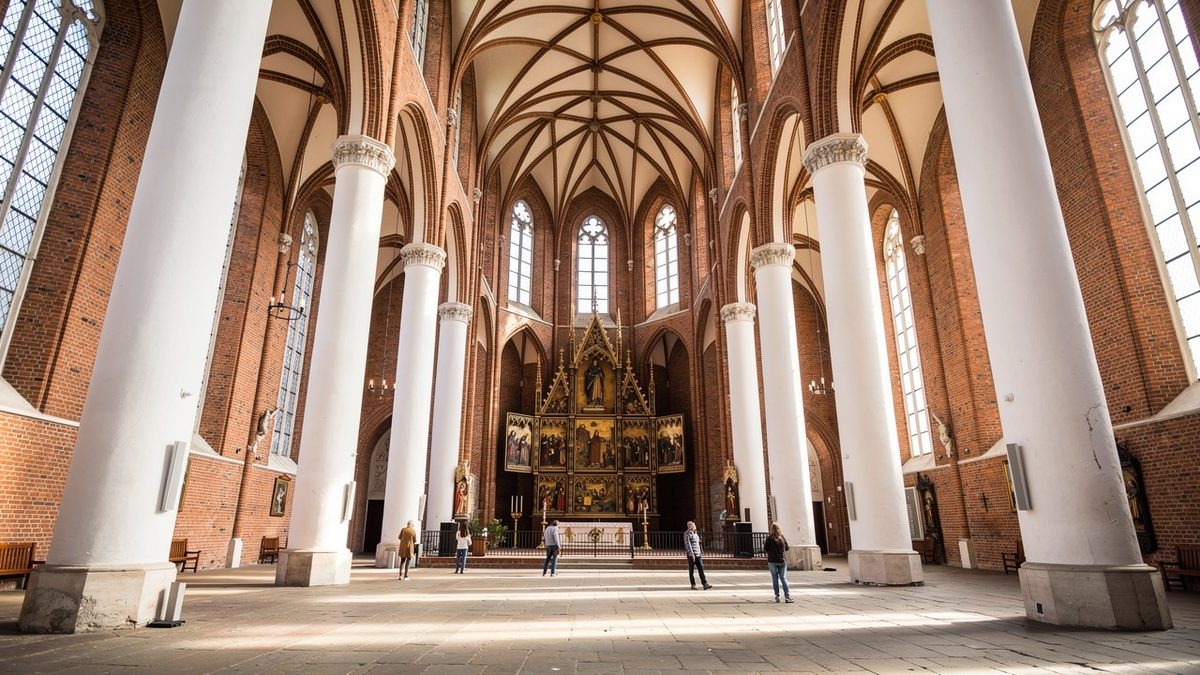
The reason to go inside is the light and the scale. St Mary's is a hall church, which means the aisles are as high as the nave, so instead of a dark tunnel you get one huge, bright room. Tall white pillars rise to star and net vaults, and the walls are whitewashed rather than painted, so the space feels almost modern. The few pieces of colour, the altars, the clock, the epitaphs of merchant families, stand out against it.
The building also carries the city's history. For four centuries after the Reformation it was Lutheran, the main church of German-speaking Danzig. In March 1945 the roof burned and parts of the vaults fell in, and it was rebuilt after the war as a Catholic church. Much of the art you see survived because it had been taken out and hidden before the fighting reached the city. If you want the bigger story of 1945 and the rebuilding of the Main Town, our Gdańsk museums guide covers where to see it.
2. Opening hours and the Sunday trap
St Mary's is a working church first and a sight second. The basilica's own visitor page lists these sightseeing hours, valid all year:
- Monday to Saturday: 8:30 to 17:30, extended to 18:30 from 1 July to 31 August
- Sundays and church holidays: 11:00 to 12:00, then 13:00 to 17:30 (to 18:30 in July and August)
There is no sightseeing during Mass or other services, and the parish asks summer visitors in particular to check the Mass times before they come. In practice this means two things. First, on a Sunday the church is effectively closed to tourists until 11:00 and again over lunch, so do not plan a Sunday morning around it. Second, on church holidays, and Poland has several (1 November, All Saints' Day, is the next one), expect the Sunday pattern rather than the weekday one.
Part of the church, with the Chapel of the Merciful Jesus, is set aside for private prayer and adoration and is closed to sightseeing. You will see signs and a barrier. Keep your voice down, do not walk through services, and if a Mass starts while you are inside, either sit quietly or leave.
There is no entry ticket for the church itself. The parish relies on donations and on the tower tickets, and the money goes to the upkeep and conservation of the building, which, for a structure this size, never ends.
3. Climbing the tower: 405 steps
The tower is the best paid viewpoint in Gdańsk and the only one that puts you right above the Main Town. The climb is 405 steps, with no lift. The lower part runs through narrow brick stairwells; higher up you pass through the roof space above the vaults on wooden and metal stairs, and in places the traffic is one-way, so expect short waits on landings when it is busy. At the top is an open platform with a view along Długa and the Long Market to the Main Town Hall, over the river to Granary Island and the shipyard cranes, and on clear days to the sea.
The ticket is sold as a donation "brick", a cegiełka, at the desk inside: 20 zł standard, 10 zł reduced. According to the visitor page, the tower is open every day from 10:00, with last entry at 18:00, extended to 20:00 in July, August and September. Note that the tower opens later than the church: if you arrive at 8:30, you can see the interior but you will have to come back for the climb.
Practical points:
- Weather: the tower is closed during storms and in bad weather. Wind at the top is strong and cold even in July, so bring a layer.
- Fitness: 405 steps is about the same as climbing a 20-storey building, with no lift to bail out. It is fine for most people who take it slowly, but not with a heavy bag, a pushchair or knee problems.
- Timing: late morning on a summer weekend is the busiest. Go at 10:00 or late afternoon.
- Last entry is the closing time: arriving five minutes before is not a plan.
One thing the tower cannot show you is St Mary's itself. For the classic skyline with the church in it, walk up Góra Gradowa, the free hill behind the main station. Our guide to the best viewpoints in Gdańsk compares the tower with Gradowa, the AmberSky wheel and the Olivia Star deck.
4. The astronomical clock at 11:57
In the north aisle stands the astronomical clock, built by the clockmaker Hans Düringer between 1464 and 1470. It is one of the great medieval clocks of Europe: a tall painted case with a dial for the hours, the phases of the moon and the positions of the sun and moon in the zodiac, a calendar of saints, and, at the top, a small theatre of figures.
The church runs the figure show once a day, at 11:57. That single show is the most common reason people miss it: they arrive at 14:00 and find a beautiful, motionless clock. If you want to see the figures move, be in the north aisle by about 11:45, because a crowd gathers in front of it, especially in summer and when tour groups are in town.
The 11:57 show also shapes how you plan the morning. A good order is: the interior at 9:00 or 10:00 when it is quiet, the tower at 10:00 or 10:30, and back down in time for the clock. Our one-day itinerary is built around exactly that sequence.
5. What to look for inside
The interior can feel empty at first, because the walls are bare and white. That is part of its character: the decoration is concentrated in a few places, and once you know where to look, an hour goes quickly.
- The high altar. The late-Gothic main altar, carved in the early sixteenth century, shows the Coronation of the Virgin, Mary being the church's patron. Stand at the end of the nave and look down its full length to understand the size of the building.
- The Beautiful Madonna. A small stone figure of Mary with the Child from around 1415, in the "beautiful style" of the period: soft folds, a gentle face. Easy to walk past; look for it in the chapels.
- The chapels. Over twenty side chapels line the walls, many founded by guilds and merchant families. Their altars, tombstones and painted epitaphs are a who's who of the old trading city.
- The vaults. Look up. The star and net vaults over the aisles and nave are among the finest in the Baltic region, and in the afternoon light they are the best thing in the building.
- The organ. St Mary's hosts organ concerts, including an organ music festival in the summer; the programme is published on the basilica's website.
- The epitaphs and the floor. Much of the floor is made of old tombstones, with worn coats of arms and inscriptions in German and Latin.
Photography for personal use is generally fine in the church, but not during services, and never with flash at people praying. The basilica also shows two short films about the clock and the church's history in its multimedia room, in Polish and in English or German, but only for organised groups that book in advance, so most individual visitors will not see them.
6. The Last Judgment: copy here, original nearby
For centuries St Mary's owned one of the most famous paintings in northern Europe: Hans Memling's triptych The Last Judgment. It was painted in Bruges for a Florentine banker, shipped towards Italy, and captured at sea in 1473 by a Gdańsk privateer, who gave it to the church. Napoleon's troops took it to Paris, it came back, it was carried off again in 1945, and it returned to Gdańsk in 1956.
The version you see in the church is a copy. The original hangs in the National Museum in Gdańsk, in a former Franciscan monastery at Toruńska 1, about ten minutes' walk south of the Main Town. If you care about art, it is worth combining the two: the copy shows you where the painting hung for five hundred years, the original shows you what all the fuss is about. Hours and prices for the National Museum are in our museums guide.
7. Around the church: Mariacka street and the Royal Chapel
Mariacka street runs from the church's east end down to the river gate. With its stone terraces, carved gargoyle drainpipes and amber shops it is the most photographed street in the city, and best in the morning before the shops open their stalls. If you want to buy amber there without overpaying, read our guide to amber shops in Gdańsk first.
Squeezed in next to the church on the north side is the Royal Chapel (Kaplica Królewska), a small Baroque church from the late seventeenth century. It was built for the city's Catholics at a time when St Mary's was Lutheran, and it is the only Baroque church in the Main Town, which makes it a striking contrast with the brick Gothic around it.
From St Mary's, everything in the Main Town is within a few minutes' walk: the Long Market and Neptune Fountain to the south, the medieval Crane on the river to the east. Our Old Town walking tour puts St Mary's in a two-kilometre loop with the other main sights.
8. How to fit it into your day
The simplest plan is to make St Mary's your late-morning stop: interior, tower, then the clock at 11:57, about 90 minutes in all. Avoid Sunday mornings, and if you are visiting on 1 November or another church holiday, check the parish website for the day's services before you go.
If you are short on time or want someone else to handle the logistics, there are a few ways to combine St Mary's with other sights.
The Westerplatte and Old Town tour picks you up at your hotel, takes you to the peninsula where the Second World War began, and then brings you back to the Main Town for the Long Market, St Mary's and the Crane, in 4 to 5 hours. It is a private tour, so you set the pace and can stay longer in the church. (ShuttleHero is run by the same local team as Gdańsk Insider.) If you would rather see the church from the outside lit up at night, the Gdańsk by night tour covers the illuminated Old Town in 2 to 3 hours.
St Mary's is also an easy first stop straight from the airport. The church is about 12 km from the terminal; if you land in the morning, a fixed-price airport transfer to the Main Town costs €30 by car for 1 to 3 people and €45 by van for 4 to 8, so you can drop your bags at the hotel and still be under the clock at 11:57. For the train and bus options, see our airport to city centre guide.
On a budget? The church is free, the tower costs 20 zł, and Góra Gradowa costs nothing. Our list of free things to do in Gdańsk has more ideas for the rest of the day.
Frequently Asked Questions
Is it free to enter St Mary's Church in Gdańsk?
Yes. There is no entry ticket for the church itself; donations go to the upkeep of the basilica. Only the tower has a ticket, sold as a donation brick: 20 zł standard and 10 zł reduced.
What are the opening hours of St Mary's Basilica?
Monday to Saturday 8:30 to 17:30, extended to 18:30 in July and August. On Sundays and church holidays 11:00 to 12:00 and 13:00 to 17:30 (to 18:30 in summer). There is no sightseeing during Mass or other services.
When is the St Mary's tower open and how many steps is it?
The tower has 405 steps and no lift. It opens daily from 10:00, with last entry at 18:00, extended to 20:00 in July, August and September. It closes during storms and bad weather. The ticket is 20 zł standard, 10 zł reduced.
What time does the astronomical clock in St Mary's perform?
Once a day, at 11:57. The clock, built by Hans Düringer between 1464 and 1470, stands in the north aisle. Arrive by about 11:45 to get a good view, because a crowd gathers in front of it.
Is the Memling Last Judgment in St Mary's the original?
No. The painting in the church is a copy. Hans Memling's original triptych hangs in the National Museum in Gdańsk at Toruńska 1, about ten minutes' walk south of the Main Town.
How long should I spend in St Mary's Church?
About an hour for the interior and the tower climb, or around 90 minutes if you also wait for the astronomical clock at 11:57. A quick look at the nave takes 15 minutes.