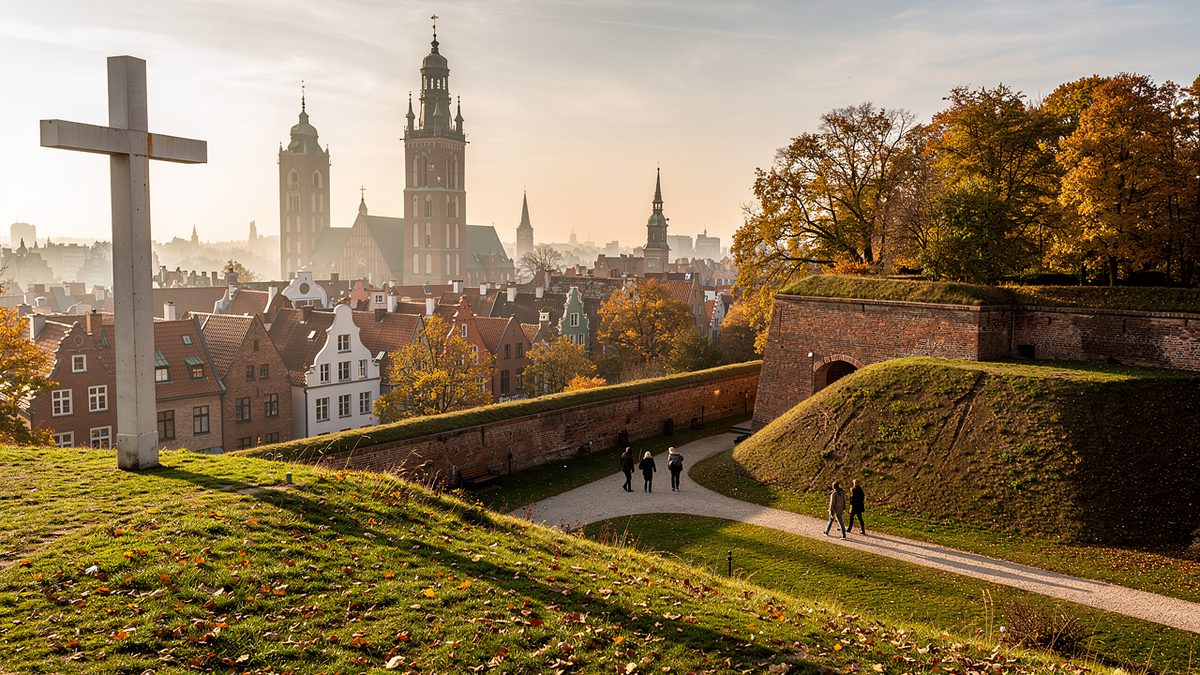
Step out of Gdańsk Główny, the main railway station, and look up to your left. Above the bus station there is a green hill with a big white cross on top. That is Góra Gradowa, Gradowa Hill, and it is the single best free view of the old city: from the top you see St Mary's, the Town Hall spire and the Crane in one line, with the shipyard cranes and the sea behind them. The hill is an old fortress, and since the city's millennium its brick barracks, caponiers and powder stores have housed the Hevelianum, a hands-on science centre named after Gdańsk's most famous astronomer. This guide covers the free part and the paid part: the viewpoints, the walk up, the 2026 tickets and hours, and how to fit the hill into a day.
Key facts
| Where | Hevelianum, ul. Gradowa 6, 80-802 Gdańsk; the hill rises directly north-west of Gdańsk Główny station and the bus station |
|---|---|
| Height and size | About 50 m above sea level; the Hevelianum grounds cover more than 20 hectares |
| Viewpoints (free) | Millennium Monument (white cross) on the Jerusalem Bastion, over 51 m above sea level; the Kurkowy high wing, facing the Old and Main Town |
| Exhibition hours | Mon closed; Tue–Fri 8:00–16:00; Sat–Sun 10:00–18:00 |
| Tickets | Around the World or With Energy! 20 zł (reduced 15 zł); package of three exhibitions 30 zł (reduced 25 zł); family package 80 zł, +20 zł per extra person |
| Weekend extras | Science show Magic vs Science 25 zł (reduced 20 zł); escape room Space Station from 180 zł for 2 people; escape room In Hevelius's Workshop 120 zł for 3 |
| Ticket desk | In the Shelter Barracks (Koszary Schronowe) next to the main parade ground of the fort; online at bilety.hevelianum.pl |
| Parking | Lower car park Gradowa 3 and upper car park at the parade ground 5.40 zł/h; ul. 3 Maja 9 6.60 zł/h; card payment |
| Closed in 2026 | 1 January, 3–6 April, 1–11 September, 1 November, 24–26 December, 30–31 December |
Key takeaways
- The view is free: you do not need a Hevelianum ticket to walk up the hill, explore the fort walls or stand by the cross
- The exhibitions are closed on Mondays and close at 16:00 on weekdays, earlier than most attractions in the centre
- Some Hevelianum pages still show an older timetable (Monday to Saturday, closed Sundays); the current 2026 hours are Tuesday to Sunday
- On rainy days tickets sell out, so buy online if you are coming with children in bad weather
- For photographs, come in the late afternoon: the sun is behind you and the brick of the Main Town turns orange
- The paths are steep and poorly lit, so go up in daylight and do not plan a night walk here
In this guide
1. Gradowa Hill: a fortress above the station
Gradowa Hill is a fortified hill about 50 metres high on the western edge of the historic centre, separated from the Main Town only by the railway lines and Wały Jagiellońskie. Its German name, Hagelsberg, is the one you will meet in older books and on period maps. Sixteenth-century chroniclers believed the oldest Gdańsk stronghold stood here, and the area is still called Grodzisko, the hill-fort site. Centuries of earthworks have reshaped the ground so thoroughly that the Hevelianum itself says nobody can now tell what the original hill looked like.
What you walk through today is a nineteenth-century Prussian fort. According to the Hevelianum, the surviving defensive buildings date mainly from 1867 to 1874: barracks built to shelter troops under artillery fire, a large caponier projecting into the moat so that soldiers could fire along it, an artillery wagon house and underground powder magazines. The hill had been fought over long before that. It was a key point in the sieges of Danzig in 1807 and 1813, during the Napoleonic wars, which is why so much effort went into rebuilding it afterwards. The fort stayed military land for a long time, and that is the main reason the hill survived as a green island in the middle of the city.
The idea of turning the fort into a science centre was born in 1997, during the celebrations of the city's thousandth anniversary. The large white cross on the summit, the Millennium Monument, belongs to the same period and marks a thousand years of Gdańsk. The Hevelianum describes itself as the first project in Europe to adapt historic military engineering for a modern science centre, and walking from a vaulted barrack room full of experiments out onto a bastion with a view of the Gothic city, it is easy to see why the idea worked.
2. The two viewpoints and when to go
The Hevelianum marks two official viewpoints, and both are free. The first is the area around the Millennium Monument, on top of the Jerusalem Bastion at more than 51 metres above sea level. This is the highest point and the classic photograph: the cross on one side, the whole roofscape of the Main Town on the other. The second is the Kurkowy high wing (Wysokie Skrzydło Kurkowe), a raised section of the ramparts a little to the south, which the Hevelianum calls the most beautiful panorama of the Old and Main Town. It looks more directly over the historic centre and is usually quieter.
From either spot you see the city in profile, which is rare in Gdańsk. In the foreground are the station and the Old Town; behind them rise St Mary's Church, the slim Town Hall spire, St Catherine's and the roof of the Crane; further out are the shipyard cranes and, on a clear day, a strip of the Gulf of Gdańsk. Our guide to the best viewpoints in Gdańsk compares Gradowa with St Mary's tower, the observation wheel and Olivia Star; Gradowa is the only one that is free and includes St Mary's itself in the frame.
When to go: the view faces roughly east and south-east over the Main Town, so the best light is in the late afternoon and just before sunset, when the sun is behind you and the brick turns orange. Mornings are hazy and backlit. In summer the golden hour comes after 20:00; from late November through December the sun sets before 16:00, so a winter visit is a lunchtime or early afternoon trip. Weather matters more than season: after rain, with a north wind, the air over the Baltic is very clear.
The hill is not a place to wander after dark. The paths are poorly lit, the slopes are steep and the park empties quickly. Enjoy the sunset and walk down while it is still light; for night views of the city, the illuminated waterfront is the better choice, and our Gdańsk at night guide covers it.
3. Getting up the hill
On foot from the station. This is how almost everyone arrives. From Gdańsk Główny, walk to the bus station (Dworzec PKS) on the north side and take the stairs next to the bus station up the slope. It takes about ten minutes and the last part is steep. The Hevelianum also lists two other ways up: from the petrol station on ul. Gradowa, and from the car park on ul. 3 Maja, which suits you if you come from Wrzeszcz. From the Long Market the whole walk is about 20 minutes.
By public transport. Trams and buses stop at Dworzec Główny, Dworzec PKS, Hevelianum (stops 01 and 02) and Brama Oliwska. SKM and regional trains stop at Gdańsk Główny, so the hill works well on the way to or from Sopot and Gdynia. A single ZTM ticket costs 4.80 zł; our getting around Gdańsk guide explains the ticket types.
By bike. There is a MEVO city bike station on the hill and racks for your own bike. The paths are shared by walkers and cyclists and are steep in places.
By car. The lower car park at ul. Gradowa 3, near the junction with ul. Dąbrowskiego, costs 5.40 zł per hour from 7:00 to 20:00. The upper car park by the fort's main parade ground, at the end of ul. Gradowa, costs the same and is charged around the clock. The car park at ul. 3 Maja 9 is 6.60 zł per hour. All three take card payment.
From the airport. Gradowa is about 15 km by road from Gdańsk Airport, and because it sits right next to the main station it is an easy first or last stop. A fixed-price private transfer from the airport to Gdańsk city centre costs €35 by car for 1 to 3 people and €45 by van for 4 to 8, and the driver can drop you at your hotel or by the station with your bags. (ShuttleHero is run by the same local team as Gdańsk Insider.) If you prefer public transport, our airport to city centre guide compares the train, bus and taxi.
4. Inside the Hevelianum: what each exhibition is
The Hevelianum is a science centre in the "touch it and try it" tradition, spread across several of the old fort buildings. It is aimed mainly at families and school groups. These are the spaces you are most likely to visit:
- Around the World (Dookoła Świata): a geography and nature journey through continents and climate zones, the most popular choice for younger children. It is fully accessible and connects by lift to the information point in the Shelter Barracks.
- With Energy! (Z Energią!): an interactive exhibition about renewable energy in the South Caponier, the most impressive of the fort buildings. Even if physics is not your thing, walk through it for the brick vaults and the firing galleries.
- Puzzle (Łamigłówka): logic puzzles, maths challenges and optical illusions, good for older children and adults. It is only sold as part of the exhibition package.
- Time Machine: Man and Projectile (Wehikuł Czasu – Człowiek i Pocisk) and Fun with History (Zabawy z Historią): the historical side of the hill, about the fort, its artillery and the soldiers who served here.
- Hevelianum Without Barriers (Hevelianum bez Barier): an exhibition designed for visitors with sight or hearing impairments.
- Creative Playground (Kreatywny Plac Zabaw): a workshop space for the youngest visitors, with separate rules and sessions.
At weekends there is more on the programme: the science show Magic vs Science, the children's workshop Adventure on the Silver Globe and two escape rooms. The programme changes with the school calendar, with special activities during winter and summer holidays, so check the calendar on hevelianum.pl before you go if you are after a particular show.
Outside the exhibitions the grounds are a park: lawns on the bastions, a playground, a nature trail and the fort walls themselves, with old gun positions you can walk along. The Hevelianum also offers a free outdoor puzzle game for families; you can print the worksheets at home or pick them up at reception.
Plan about two to three hours for the exhibition package with children, plus half an hour for the viewpoints. Adults without children usually find one exhibition plus the walk around the fort enough.
5. Tickets and hours in 2026
The park and viewpoints are free. You pay only for the indoor attractions. These are the individual prices on the Hevelianum's price list as of November 2026:
| Ticket | Days | Price |
|---|---|---|
| Around the World (exhibition) | Tue–Sun | 20 zł, reduced 15 zł |
| With Energy! (exhibition) | Tue–Sun | 20 zł, reduced 15 zł |
| Exhibition package: Around the World, Puzzle, With Energy! | Tue–Sun | 30 zł, reduced 25 zł; family 80 zł (+20 zł per extra person) |
| Magic vs Science (science show) | Sat–Sun | 25 zł, reduced 20 zł |
| Adventure on the Silver Globe (children's workshop) | Sat–Sun | child 25 zł, accompanying adult 10 zł |
| Escape room: Space Station | Sat–Sun | 180 zł for 2, 210 zł for 3, 240 zł for 4, 270 zł for 5, +20 zł per person above 5 |
| Escape room: In Hevelius's Workshop | Sat–Sun | 120 zł for a group of 3, +15 zł per extra person |
For most visitors the exhibition package at 30 zł is the obvious choice: for 10 zł more than a single exhibition you get all three. A family of four pays 80 zł for the package instead of 120 zł at the standard price. The Hevelianum accepts the Polish Large Family Card, the Pomeranian Tourist Card (Pomorska Karta Turysty), the Karta do Kultury and the Gdańsk Resident Card for discounts.
Opening hours: the exhibitions on Gradowa Hill are closed on Mondays, open Tuesday to Friday from 8:00 to 16:00 and Saturday and Sunday from 10:00 to 18:00. The early weekday start is for school groups, so individual visitors usually have a calmer time in the afternoon. In 2026 the centre is also closed on 1 January, 3 to 6 April (Easter), 1 to 11 September (technical break), 1 November, 24 to 26 December and 30 to 31 December.
A small trap: the site footer and a few older pages still say "Monday to Saturday 10:00 to 18:00, Sunday closed", the previous timetable. The plan-your-visit page and the 2026 price list both give the Tuesday to Sunday hours above, and that is what we have used. If Monday is your only free day, go up for the view and save the exhibitions for another trip.
The Hevelianum warns that on rainy days visitor numbers jump and tickets sell out quickly, so buy online at bilety.hevelianum.pl. The ticket desk is in the Shelter Barracks, next to the fort's main parade ground (the majdan).
6. Who was Hevelius?
The centre is named after Johannes Hevelius (Jan Heweliusz in Polish, 1611–1687), the Gdańsk astronomer who became one of the best-known scientists of seventeenth-century Europe. By day he was a brewer and a city councillor; by night he observed the sky from an observatory he built across the rooftops of his houses in the Old Town. His Selenographia of 1647 was one of the first detailed atlases of the Moon, and his star catalogue introduced constellations that astronomers still use, among them the Lynx, the Sextant and the Shield.
You can follow his traces in the city in an afternoon. His statue stands in front of the Old Town Hall on ul. Korzenna, a short walk from the foot of Gradowa Hill, and he is buried in St Catherine's Church nearby. The Hevelianum keeps him at the centre of its programme, with astronomy workshops, the "In Hevelius's Workshop" escape room and sky-watching events.
7. Accessibility, parking and food
Accessibility. The Hevelianum lists Around the World, With Energy! (on levels 0 and +1), Hevelianum Without Barriers and the Creative Playground as accessible to wheelchair users. There are lifts in the Shelter Barracks (door 89 cm wide, cabin 108 by 139 cm), the Artillery Wagon House and the South Caponier, and accessible toilets in all three buildings. The paths up the hill are steep, so if you use a wheelchair, arrive by car or taxi: there are three disabled parking spaces at the lower car park at Gradowa 3 and one wider space at the upper car park by the parade ground. The centre also publishes an easy-to-read guide and a plain-language pre-visit guide that marks the exhibition stations with a lot of sensory stimuli.
Food. Restaurant Gradova (ul. Gradowa 8) is on the hill, next to the exhibitions, with local ingredients and a view. Show your Hevelianum ticket before ordering for 10% off menu dishes and soft drinks. There is no other café on the hill, so for a cheap lunch walk back down to the centre; our guide to what to eat in Gdańsk has ideas.
A second site. The Hevelianum also runs the Dom Zdrojowy in Brzeźno, a restored spa house by the beach that serves as an environmental education centre. It is a separate visit with its own programme, best combined with a walk on Brzeźno beach.
8. How to fit Gradowa into your day
Because the hill sits beside the main station, it fits around trains, transfers and the Old Town easily. Three ways to use it:
- Sunset from the hill (1 hour, free). Spend the day in the Main Town, walk up via the bus-station stairs about an hour before sunset, then walk back down to the Old Town for dinner while it is still light. This is the best free hour in the city.
- Rainy day with children (half a day). Arrive on a weekend at 10:00 or a weekday after lunch, buy the exhibition package online, eat at Gradova and walk out to the cross if the rain stops. Our Gdańsk with kids guide and rainy day guide list more options nearby.
- Arrival or departure day. Drop your bags at your hotel, climb Gradowa for a first look at the city, then start your Old Town walk from the bottom of the hill. With a single day in Gdańsk, swap a paid tower for Gradowa to save time and money.
On a Monday the exhibitions are closed but the hill is open, so combine the viewpoint with the free Monday at the Main Town Hall and Artus Court for a day without tickets.
If you want to see more of the coast in the same trip, the Tri-City tour covers Gdańsk, Sopot and Gdynia in about 8 hours with a private driver who collects you from your hotel. The Westerplatte and Old Town tour is shorter, 4 to 5 hours, and covers the place where the Second World War began plus the main Old Town sights.
Prefer to stay on foot? Everything in this guide is within a 20-minute walk of the Long Market, and our free things to do in Gdańsk guide has more ideas like Gradowa that cost nothing.
Frequently Asked Questions
Is Gradowa Hill in Gdańsk free to visit?
Yes. The park, the paths, the old fort walls and both official viewpoints, by the Millennium Cross and on the Kurkowy high wing, are free and open to walk around. You only pay for the Hevelianum's indoor exhibitions, shows and escape rooms.
How much are Hevelianum tickets in 2026?
A single exhibition, Around the World or With Energy!, costs 20 zł (reduced 15 zł). The package of three interactive exhibitions costs 30 zł (reduced 25 zł) and a family package 80 zł plus 20 zł for each extra person. The weekend science show Magic vs Science is 25 zł (reduced 20 zł).
What are the Hevelianum opening hours?
The exhibitions on Gradowa Hill are closed on Mondays, open Tuesday to Friday 8:00 to 16:00 and Saturday and Sunday 10:00 to 18:00. In 2026 the centre is also closed on 1 January, 3 to 6 April, 1 to 11 September, 1 November, 24 to 26 December and 30 to 31 December.
How do you get to Gradowa Hill from Gdańsk Główny station?
Walk north from the main station towards the bus station and take the stairs next to it up the slope, about ten minutes and steep in parts. Trams and buses stop at Dworzec Główny, Dworzec PKS, Hevelianum and Brama Oliwska. There is a MEVO bike station on the hill.
Where is the best viewpoint on Gradowa Hill?
The Hevelianum names two: the area around the Millennium Monument, the large white cross on top of the Jerusalem Bastion at over 51 metres above sea level, and the Kurkowy high wing, which it calls the finest panorama of the Old and Main Town. Late afternoon light is best.
Is the Hevelianum good for children on a rainy day?
Yes, it is one of the best rainy-day options in Gdańsk for children of about 6 to 14, with hands-on exhibitions in the old fort buildings. The centre warns that tickets sell out quickly on rainy days, so buy them online at bilety.hevelianum.pl before you go.
Is the Hevelianum accessible for wheelchair users?
Partly. The Around the World, With Energy! (levels 0 and +1), Hevelianum Without Barriers and Creative Playground spaces are wheelchair-accessible, with lifts in the Shelter Barracks, the Artillery Wagon House and the South Caponier. The hill paths are steep, so arrive by car: there are three disabled spaces at the lower car park at Gradowa 3.