Gdańsk is a medieval port city rebuilt after 1945, so you get both sides of that history: wide new museums with lifts on every floor, and old merchant houses, church towers and a harbour crane with steep stairs and no lift. The city is flat, the river is lined with level promenades, and most trams and buses can kneel and put down a ramp. The trouble spots are cobbles, a few historic doorways and paperwork that is written for Polish residents. This guide covers what we checked on the official accessibility pages in November 2026, from the airport assistance desk to the beach wheelchairs in Sopot.
Key facts
| Airport assistance | Free; request through your airline at least 48 h before the flight; service point in the T2 departure hall plus call points at the terminal and car park. No service 00:00–05:00 |
|---|---|
| Airport waiting times (booked) | Departures: 80% within 10 min, all within 30 min. Arrivals: all within 20 min. Unbooked: up to 45 min |
| SKM commuter trains | Help boarding and leaving the train if requested at least 24 h ahead: +48 58 721 12 11; lifts at Gdańsk Śródmieście, Wrzeszcz, Oliwa, Sopot and others |
| Trams and buses | Most vehicles have a ramp and can kneel at the stop. Free travel applies only to holders of a Polish disability ID |
| Fully step-free museums | Museum of the Second World War (4 lifts), European Solidarity Centre (3 lifts), Amber Museum (lift entrance at the back), Maritime Culture Centre |
| Not accessible | Upper floors of the Crane, St Mary's tower (about 400 steps), the museum ship Sołdek, Uphagen House above the ground floor |
| Parking | Blue EU card = free on marked disabled bays only; elsewhere in the paid zone you pay |
| Beaches | Sopot accessible beach at entrance 23, 15 June–15 September, amphibious chairs 9:30–17:30, book on 609 680 820 |
Key takeaways
- Book airport help with the airline when you book the flight, and avoid flights that land between midnight and 5:00
- Build your days around the big modern museums: the WWII Museum, the European Solidarity Centre and the Amber Museum have lifts to every level
- Main Town Hall has a lift, but you must book it 2 to 3 days ahead with the museum's accessibility coordinator
- Ring SKM a day before any train trip to Sopot or Gdynia, and check which stations have lifts
- Foreign disability cards do not give free city transport or free parking in the paid zone; budget for tickets
- For summer, Sopot's beach at entrance 23 has a boardwalk to the water and amphibious wheelchairs
In this guide
1. Arriving at Gdańsk Airport
Assistance at Gdańsk Lech Wałęsa Airport is free and covers the whole journey from the car park to your seat on the plane, and from the plane to the arrivals hall on the way in. It is run by a dedicated PRM team (passengers with reduced mobility) with an ambulift, a stair-climber and a narrow aisle chair for boarding. You request it through your airline, not through the airport, and the airport asks for at least 48 hours' notice. Do it when you buy the ticket: most airlines have a tick box or a special-assistance form, and the request is then passed to the airport with your booking.
On the day, report to the service point in the departure hall of Terminal T2, or press one of the marked call points at the terminal entrance and in the parking area by the reserved bays. With a booked request the airport's own standard is that 80 per cent of departing passengers are met within 10 minutes and everyone within 30. On arrival, the team should be at the aircraft within 20 minutes. Without a booking, expect to wait up to 45 minutes.
One trap is printed in small type on the airport's quality page: assistance is not provided between 00:00 and 05:00. Late-night arrivals are common on budget routes into Gdańsk, so check your landing time before you book. If you are flying with your own wheelchair, tell the airline about the type, weight and battery (for powered chairs) at the same time. Our Gdańsk Airport departures guide covers parking, the lounge and security in more detail.
From the airport to the city you have three options. The airport train runs to Gdańsk Wrzeszcz in about 20 minutes, where you change to the SKM, and city buses run into town; both are covered in our airport to city centre guide. The third option is a pre-booked car or van straight to your hotel door, which we cover in section 7.
2. The Main Town: surfaces and a step-free route
The historic centre (Główne Miasto, the Main Town) is flat. There are no hills between the Golden Gate and the river, which makes it easier than most old towns in Europe. The difficulty is the surface. The Royal Route along Długa Street and the Long Market is paved with stone, mostly laid in flat slabs with cobbled strips and edges, and some side streets such as Mariacka are cobbled with steps up to the terraces of the houses. Many shops and cafés on these streets have one or two steps at the door.
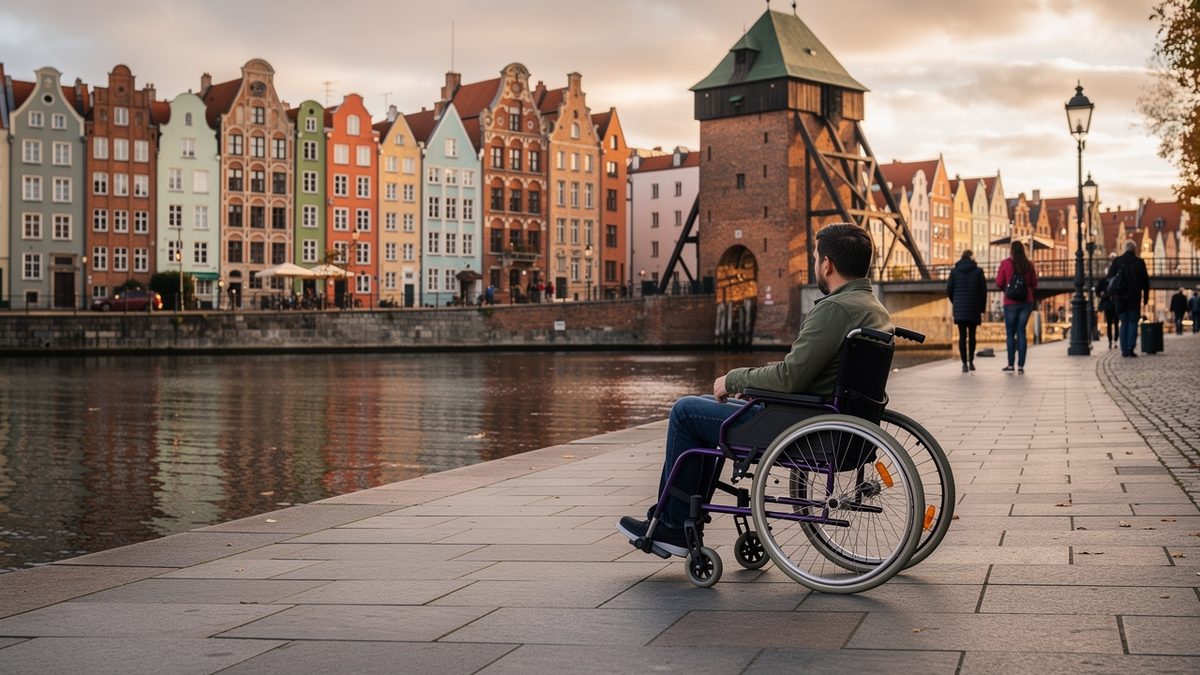
The easiest loop for a manual chair is the river. The Long Embankment (Długie Pobrzeże) runs along the Motława from the Green Gate past the Crane, and it is wide, level and paved in large slabs. Across the footbridge, the promenades on Ołowianka and Granary Island are newer and smoother still. A good step-free afternoon is: start at the Green Gate, roll the length of the Long Embankment to the Crane, cross to the Maritime Culture Centre on Tokarska Street, and come back along the opposite bank. You see the whole waterfront without a cobble.
Długa and the Long Market are worth doing too, at a slow pace and ideally with a companion. Use the centre of the street, where the slabs are flattest, and avoid the cobbled gutters by the house fronts. Mariacka Street, the amber street behind St Mary's, is the hardest: lovely to look at from the end, harder to roll along. Our getting around guide has a map of the centre and the tram stops closest to the old gates.
3. Museums: which have lifts and which do not
The rule of thumb is simple: the new museums are fully accessible, the medieval ones are partly accessible, and the towers are not. All the museums below publish an accessibility statement, and we read each one in November 2026.
Museum of the Second World War
The best-equipped museum in the city. It has four lifts reaching every level of the underground exhibition, accessible toilets on levels −3 and −2, and wheelchairs to borrow at the information desk. There are six disabled bays in the paid underground garage, though the garage pay machine is mounted too high for many wheelchair users, so bring a companion or pay by app. Two exhibition sections, "The Road to War" and "September", have narrower passages. Visitors with a disability and their carer pay the reduced ticket of 23 zł (normal 33 zł), and entry is free on Tuesdays (10:00 to 16:00, capped at 2,500 visitors). Details in our WWII Museum guide.
European Solidarity Centre
The rust-coloured building by the shipyard gate has three panoramic lifts to every floor, automatic doors without thresholds, accessible toilets on levels 0 to 3, two adult wheelchairs to borrow and ramps on the roof terrace. The one weak point is outside: the approach to the main entrance is cobbled. A visitor with a disability and their assistant both get a reduced ticket. See our European Solidarity Centre guide.
Museum of Gdańsk branches
The city museum runs several historic buildings, and access varies a lot:
- Amber Museum: fully accessible; the lift entrance is round the back, next to the Miller's House.
- Main Town Hall: the only lift is in the museum's office wing and has to be booked 2 to 3 days ahead with the accessibility coordinator (dostepnosc@muzeumgdansk.pl). It reaches every exhibition level, but not the tower. The ground-floor Pile Gallery is accessible without booking.
- Artus Court: entry is from the courtyard on Chlebnicka Street by a portable ramp with a steep 19-degree slope; the Great Hall, ticket desk and toilets are accessible, but powered wheelchairs do not fit through the doors.
- Uphagen House: ground floor only, and the toilets are not accessible.
- Not accessible: the Long Street Gate complex, the Museum of Gdańsk Science in St Catherine's tower, Guardhouse No. 1 at Westerplatte and the water forge in Oliwa.
Our Town Hall and Artus Court guide has the opening hours and ticket prices.
National Maritime Museum and the Crane
The medieval Crane is the city's symbol, but only its ground floor is accessible: the ticket office, a film and a hologram display. There is no lift to the upper floors with the treadwheels. There is an accessible toilet in the museum shop and two disabled bays about 12 metres away. Across the river, the Maritime Culture Centre on Tokarska Street is step-free on all floors and the most rewarding branch for wheelchair users. The granaries on Ołowianka have a lift and a stair platform, both operated by staff, so ask at the desk. The museum ship Sołdek is not accessible. More in our Crane and Maritime Museum guide.
Hevelianum on Gradowa Hill
The fort above the main station has lifts in the barracks and the south caponier, accessible toilets, three disabled bays at ul. Gradowa 3 and another on the upper car park. Entry is free for people over 16 with a significant disability, and for their carer. Drive or take a taxi to the upper car park rather than tackling the hill on foot. See our Hevelianum guide.
St Mary's Church
The nave of the largest brick church in Europe is free and at ground level, but the tower has almost 400 steps and no lift. The church does not publish an accessibility statement, so look at the entrance before you go in.
4. Trams, buses and SKM trains
The city's own tourism office says that the vast majority of trams and buses have ramps and can lower themselves at the stop. In practice you wait by the door marked with the wheelchair symbol and catch the driver's eye, so the ramp goes down before the doors close.
Tickets are where foreign visitors get caught. ZTM Gdańsk gives free travel to people with a significant disability and an adult carer, and to blind people with a guide, but the proof required is a Polish disability ID issued by a Polish assessment board. Foreign cards are not mentioned, so plan to buy normal tickets. A single ride costs 4.80 zł and a 24-hour ticket 22 zł; our getting around guide has the full list.
The SKM commuter trains link Gdańsk, Sopot and Gdynia every few minutes and are the fastest way along the coast. SKM staff will help you board and leave the train if you call at least 24 hours ahead on +48 58 721 12 11; later requests are handled where possible. Station lifts are the key detail:
- Gdańsk Główny (main station): lift to platform 3; platforms 4 and 5 are reached step-free from the street
- Gdańsk Śródmieście: three lifts, also linking to the trams
- Gdańsk Wrzeszcz: two lifts
- Oliwa, Przymorze, Żabianka, Sopot Wyścigi, Kamienny Potok: lifts
- Sopot: two lifts
- Gdańsk Stocznia and Gdynia Stocznia: no lifts at the outer ends of the footbridge
When we checked, the lift at Gdańsk Politechnika was out of service until about 20 November 2026. If you are travelling on long-distance trains from Gdańsk Główny, request help through the train company at least 48 hours ahead to be safe; the station meeting point is the waiting area marked with blue signs in the main hall. Our Sopot and Gdynia by train guide covers the SKM timetable and tickets.
5. Parking with a blue badge
If you bring your own car or rent one, the city's road authority sets one rule that surprises visitors. In Gdańsk's paid parking zone, the EU-model blue parking card lets you park free only in bays marked for disabled drivers. In ordinary bays in the zone you pay the normal fee. Free parking anywhere in the zone requires a local Gdańsk permit that is issued against a Polish certificate, so visitors cannot get it. The marked bays are scattered around the Main Town, and the museums above list their own bays. Display the card clearly behind the windscreen.
6. Beaches and Sopot pier
The best set-up on the coast is in Sopot. From 15 June to 15 September the beach at entrance 23 is run as an accessible beach, with a 65-metre boardwalk and a mat down to the waterline, an accessible pavilion and two amphibious wheelchairs that can go into the sea. They are available daily from 9:30 to 17:30 and you book them by phone on 609 680 820 before 15:00. Entrances 29 and 37 also have rubber mats over the sand.
Sopot pier, the longest wooden pier in Europe, has ramps at the arcades by the entrance, a lift and two toilets at the far end, and a wheelchair to borrow. The pier charges a fee from 10 April to 30 September (normal ticket 10 zł). Disabled visitors up to the age of 26 enter free, and a carer pays 5 zł with a first-degree disability certificate. Outside the season the pier is free.
Gdańsk's own beaches at Stogi and Brzeźno have had amphibious wheelchairs with the lifeguards in summer and walkways at many beach entrances, but the city has not published a current season page, so ask the lifeguards on arrival.
We could not find a public boat on the Motława with confirmed wheelchair access. If a river cruise matters to you, call the operator at the quay before you book and ask about the gangway.
7. Door-to-door transfers and tours
Public transport works, but the gaps between stops, kerbs and the booking calls add up. Many visitors with a wheelchair prefer a car that takes them from the arrivals door to the hotel door. Our own company, ShuttleHero, runs fixed-price airport transfers to Gdańsk, Sopot and Gdynia. (ShuttleHero is run by the same local team as Gdańsk Insider.)
Be clear about what this is. Our cars and vans are standard vehicles: they have no ramp and no lift, so you need to be able to move from your chair to a seat, with help from your companion. A folding manual wheelchair travels in the luggage space. For a wheelchair plus suitcases, choose the van even if you are only two or three people; there is more room for the chair and for transferring. Mention the wheelchair when you book so the driver knows before pickup. If you need to stay seated in a powered chair during the journey, you need a specialist vehicle with a ramp, and we do not offer that.
The Tri-City tour is a good fit if long walks are the problem: the car stops close to the Long Market, Sopot pier and the Gdynia waterfront, so you see the three towns in one day with short distances at each stop. Routes to Sopot and Gdynia have their own pages with the van prices.
Frequently Asked Questions
Is Gdańsk wheelchair friendly?
Mostly, yes. The city centre is flat, the riverside promenades are wide and level, and most trams and buses have ramps. The new museums, such as the Museum of the Second World War and the European Solidarity Centre, have lifts to every floor. The difficult parts are cobbled side streets, steps into older shops and the historic towers, which have no lifts.
How do I get wheelchair assistance at Gdańsk Airport?
Request it through your airline at least 48 hours before the flight, ideally when you book. The free service runs from the car park or terminal entrance to your aircraft seat, with an ambulift and an aisle chair. Report to the service point in the T2 departure hall or use a call point. No assistance is provided between 00:00 and 05:00.
Which Gdańsk museums are accessible for wheelchair users?
The Museum of the Second World War (four lifts), the European Solidarity Centre (three lifts), the Amber Museum (lift entrance at the back) and the Maritime Culture Centre on Tokarska Street are step-free on every floor. Main Town Hall has a lift that must be booked 2 to 3 days ahead. Only the ground floor of the Crane is accessible, and St Mary's tower has no lift.
Can I travel free on Gdańsk public transport with a disability?
Only with a Polish disability ID. ZTM Gdańsk gives free travel to people with a significant disability and an adult carer, but the proof is a card issued by a Polish assessment board, and foreign cards are not listed. Visitors should buy normal tickets: 4.80 zł for a single ride or 22 zł for 24 hours.
How do I get help on SKM trains to Sopot and Gdynia?
Call SKM on +48 58 721 12 11 at least 24 hours before you travel, and staff will help you board and leave the train. Gdańsk Śródmieście, Wrzeszcz, Oliwa and Sopot have lifts; Gdańsk Główny has a lift to platform 3 and step-free access to platforms 4 and 5. Gdańsk Stocznia and Gdynia Stocznia have no lifts at the outer ends of the footbridge.
Can I park free in Gdańsk with a blue EU disability badge?
Only in bays marked for disabled drivers. In ordinary bays in Gdańsk's paid parking zone, blue badge holders pay the normal fee. Free parking across the whole zone needs a local Gdańsk permit issued on a Polish certificate, which visitors cannot get.
Is there an accessible beach near Gdańsk?
Yes. In Sopot, the beach at entrance 23 has a 65-metre boardwalk and a mat to the waterline, an accessible pavilion and two amphibious wheelchairs from 15 June to 15 September, daily 9:30 to 17:30. Book the chairs by phone on 609 680 820 before 15:00. Sopot pier has ramps, a lift at the far end and accessible toilets.