Gdańsk was a beer town long before it was a tourist town. In the Hanseatic centuries the city had a whole street of brewers, exported a thick, strong ale called Jopen as far as England, and in 1598 gave the world Goldwasser, the herbal liqueur with flakes of gold floating in it. Most of that industry disappeared, but the last fifteen years have brought brewing back: there are brewpubs in a riverside granary, in an old Prussian riding hall and in the nineteenth-century city brewery itself. This guide tells you where to drink what, what it costs, and the two local rules that catch visitors out: the night ban on shop sales and the ban on drinking outdoors.
Key facts
| Goldwasser | Herbal liqueur with 22-carat gold leaf, about 40%; Ambrosius Vermöllen began making it in Gdańsk in 1598 |
|---|---|
| Where to try Goldwasser | Kamienica Goldwasser, ul. Długie Pobrzeże 22; Mon–Thu 12:00–22:00, Fri–Sun 10:00–22:00 |
| Brewpub in the Main Town | Brovarnia, ul. Szafarnia 9, in a granary by the marina; tasting set of 3 × 0.3 l; weekend tables by phone only |
| Historic Danzig beers | Browar PG4, ul. Podwale Grodzkie 4, near Gdańsk Główny; revivals such as Jopen and Krollinger |
| Wrzeszcz breweries | Vrest, Garnizon Kultury, ul. Słowackiego 23, Mon–Sun 12:00–24:00; Nowy Browar Gdański in the former Danziger Aktien-Bierbrauerei (1873–2001) |
| Typical price | Half a litre of local beer 15–25 zł; waterfront at the top of the range |
| Shop sales | No alcohol from shops or petrol stations 22:00–6:00 anywhere in Gdańsk since 1 September 2025; bars and restaurants exempt |
| Drinking outdoors | Banned in public places under Polish law; usual on-the-spot fine 100 zł |
Key takeaways
- Goldwasser is the drink Gdańsk invented; one small cold glass after a fish dinner is the local way to take it
- The best beer is brewed on site: Brovarnia in the Main Town, PG4 by the station, Vrest and Nowy Browar Gdański in Wrzeszcz
- Ask for the darkest beer on the list: Baltic porter is the region's own style, strong and smooth
- Buy any bottles for your room before 22:00; after that, shops and petrol stations will refuse
- Do not drink on the riverside, the beach or in the street: it is illegal and fines are common in summer
- Wrzeszcz is cheaper than the waterfront and only five minutes away by commuter train
In this guide
- Key facts
- A brewing city: Jopen, Piwna Street and Hevelius
- Goldwasser: the gold-flecked liqueur
- Four brewpubs worth the walk
- What to order: Baltic porter and the local line-up
- Prices and how ordering works
- The rules: night sales ban, drinking outdoors, driving
- A beer-and-Goldwasser evening, step by step
- FAQ
1. A brewing city: Jopen, Piwna Street and Hevelius
Gdańsk brewed beer for most of its thousand years, and you can still read it in the street plan. ul. Piwna, Beer Street, runs from the Long Market area towards the Great Armoury; its old German name was Jopengasse, after the beer that made the city famous. Brewers' houses lined it, and brewing was one of the guilds that ran the medieval and early modern town.
Jopen (Jopenbier) was the city's export. It was not a beer you drank by the pint: it was boiled for hours into a dark, very strong, almost syrupy brew that kept for months in a ship's hold. English and Dutch merchants bought it as a base for brewing and for medicine, and it travelled across the North Sea for centuries. The brewers of Gdańsk guarded the recipe through their guild, and the name survived the beer itself, which faded away in the nineteenth century.
The city's most famous scientist was a brewer too. Johannes Hevelius, the seventeenth-century astronomer, ran the family brewery and sat on the city council by day and mapped the Moon from his rooftop observatory by night. The science centre named after him is on Gradowa Hill, and our Hevelianum and Gradowa Hill guide covers it.
Industrial brewing arrived in the nineteenth century. In 1873 the Danziger Aktien-Bierbrauerei opened in Kuźniczki in Wrzeszcz, on a site where beer had been brewed since the eighteenth century. At its peak it produced up to 175,000 hectolitres a year, and it carried on under Polish names after the war until it closed in 2001. Today the restored brewhouse is a brewpub again, which is a good reason to go out to Wrzeszcz (more below).
2. Goldwasser: the gold-flecked liqueur
Goldwasser is the one drink that is entirely Gdańsk's own. The story usually told begins with Ambrosius Vermöllen, a distiller from the Netherlands who took Gdańsk citizenship on 6 July 1598 and began producing a sweet herb-and-root liqueur with flakes of 22-carat gold leaf suspended in it. His descendants made it in a house on ul. Szeroka marked with a salmon, which gave the brand its old name, Der Lachs. The building, the House under the Salmon (Dom pod Łososiem) at Szeroka 52/53, still stands in the Main Town, a short walk from the Crane, and is worth a look for the salmon carved over the door.
There is also a legend, which the Goldwasser restaurant tells on its own website: the citizens of Gdańsk threw so many gold coins into the Neptune Fountain on the Long Market that the water turned into a precious drink. The fountain is the best place to tell it, and the liqueur is the best way to end it.
What it tastes like. Goldwasser is around 40 per cent alcohol, sweet, and heavy with aniseed, cardamom-like spice and herbs. The gold does not change the taste; it is a show of wealth from a merchant city. Drink it cold, in a small glass, after a meal rather than before, and give the bottle a gentle turn before pouring so the flakes rise. If you buy a bottle as a gift, the liqueur sold today under the Gdańsk name is not distilled in the old house on Szeroka, so judge it as a souvenir rather than a piece of living local craft.
Where to try it. The most obvious place is the Kamienica Goldwasser restaurant on the waterfront at ul. Długie Pobrzeże 22, between the Green Gate and the Crane, with a large terrace over the Motława. It is open Monday to Thursday 12:00 to 22:00 and Friday to Sunday 10:00 to 22:00, serves the liqueur by the glass and works it into desserts and game dishes. Most bars and restaurants in the Main Town also have a bottle behind the counter, so you do not need to plan your evening around one address.
3. Four brewpubs worth the walk
Gdańsk has plenty of multi-tap bars pouring Polish craft beer, but the most rewarding stops are the places that brew on the premises. These four are easy to reach and very different from each other.
Brovarnia: beer in a granary on the marina
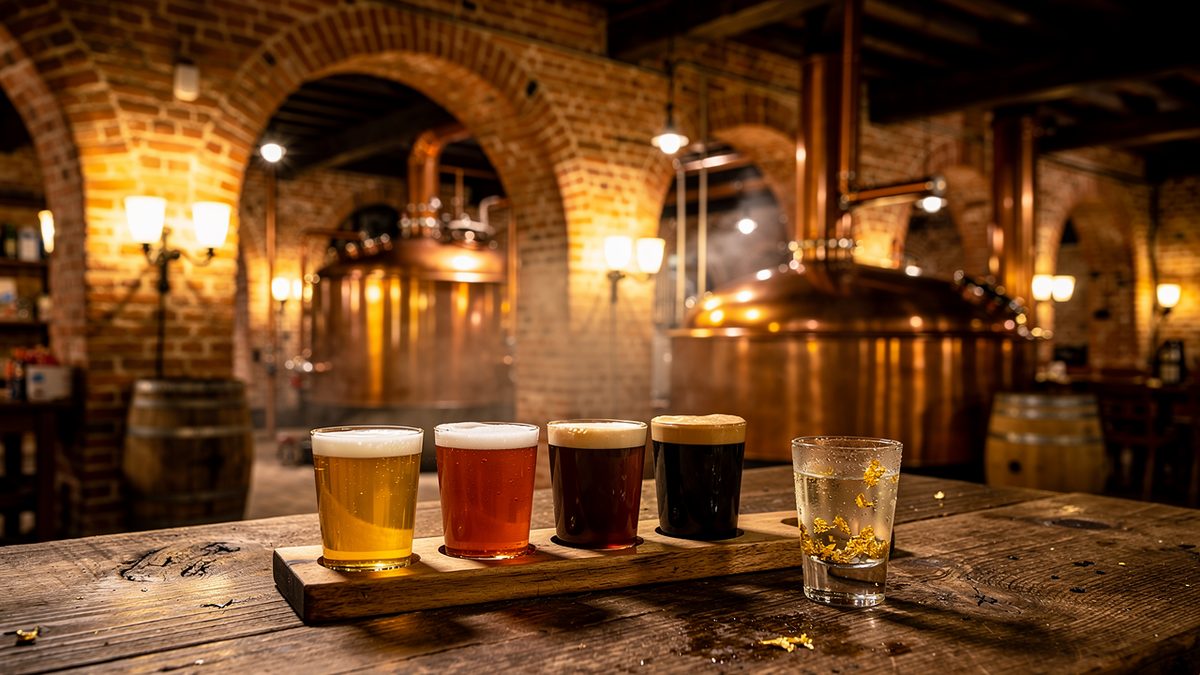
Brovarnia is at ul. Szafarnia 9, inside a 400-year-old granary that is now part of the Hotel Gdańsk, on the marina opposite the Main Town. It is the closest brewpub to the Long Market, a ten-minute walk across the footbridge by the Crane. The copper kettles are in the room, the house pils is the flagship, and the menu changes with the season. If you want to compare, order the tasting set of three 0.3-litre glasses. Brovarnia takes weekend reservations by phone only, so call ahead for a Friday or Saturday evening table.
Browar PG4: the old Danzig beers, revived
Browar PG4 takes its name from its address, ul. Podwale Grodzkie 4, a few minutes from Gdańsk Główny station on the edge of the Old Town. It is the place for the history in this guide: alongside modern pils, wheat and smoked beers, it brews revivals of historic Gdańsk styles, including a Jopen and a Krollinger. The Jopen is the one to try, in a small measure: it is strong, dark and sweet, nothing like a lager. Ask whether they have a tasting board of small pours across the whole list. Because it is by the station, PG4 is also the best stop if you have a train or transfer to catch.
Vrest: a neighbourhood brewery in Wrzeszcz
Vrest is at Garnizon Kultury, ul. Juliusza Słowackiego 23, in Wrzeszcz, inside the former Prussian barracks quarter now known as Garnizon. It is open every day from 12:00 to 24:00 (or until the last guest), and the brewery describes itself as a local brewery for the neighbourhood rather than a tourist venue. The core line is short and well made: a Jasny (amber, 4.4%), a Pszeniczny wheat beer (4.4%), a Ciemny (dark, 5%, an interpretation of German Altbier with coffee and chocolate notes), a Pilzner (4.4%, six weeks of cold conditioning, dry-hopped with Saaz) and a rotating experimental beer called Niecodzienny. You can also drink the same beer at the café in Stary Maneż, the restored riding hall next door that is now a concert venue, which makes Vrest a natural pre-gig stop.
Nowy Browar Gdański: the big one in the old city brewery
Nowy Browar Gdański occupies the old Danziger Aktien-Bierbrauerei in Kuźniczki, Wrzeszcz. It is a brewery restaurant on a large scale: more than 1,200 square metres, about 450 seats and around 35 screens for sport. Go for the building and the beer brewed in it, and for a big group or a football night. It is not the place for a quiet glass, and on match days it is full.
Getting to Wrzeszcz: the SKM commuter train from Gdańsk Główny reaches Gdańsk Wrzeszcz in about five minutes; trams run there too. Our getting around Gdańsk guide explains the tickets, and our neighbourhoods guide explains why Wrzeszcz is where many locals actually go out.
4. What to order: Baltic porter and the local line-up
Polish bars still sell mostly pale lager, and there is nothing wrong with a cold half-litre on a summer terrace. But if you want something with a sense of place, these are the styles to look for:
- Baltic porter. The region's own style. It grew out of the English porter and stout that ships carried across the North Sea, and the Baltic ports brewed their own stronger versions. Polish Baltic porters are usually cold-fermented like lagers and around 8 to 10 per cent, with coffee, dark chocolate, plum and liquorice flavours. Several big Polish breweries make one, and the craft brewers make many more, some aged in barrels. Drink it slowly, from a small glass, ideally on a cold evening. Enthusiasts celebrate Baltic Porter Day in January.
- Jopen and other revivals. At PG4, try the historic Gdańsk beers. They are curiosities rather than session beers, which is exactly the point.
- Pils from the brewpubs. Brovarnia's and Vrest's pilsners are fresh, unpasteurised and a fair test of a brewery. Order one first.
- Smoked beer. Rauchbier and the Polish smoked wheat style, grodziskie, appear on craft lists from time to time. Light, smoky and low in alcohol, they go well with smoked Baltic fish.
- Nalewki. Not beer at all, but the home-style fruit and herb infusions (cherry, quince, honey) that Polish bars pour by the small glass. A good alternative to Goldwasser if you find it too sweet.
Food pairing is easy in a fishing port. A light pils with fried flounder, a porter with smoked eel or a pork knuckle, and Goldwasser to finish. Our guide to what to eat in Gdańsk covers the dishes, and in December the Christmas market adds mulled wine at 14 to 18 zł a cup.
5. Prices and how ordering works
Gdańsk is still good value by Western European standards, but prices rise sharply as you approach the water. Typical bar prices in November 2026:
| Drink | Where | Typical price |
|---|---|---|
| Half a litre of local lager or brewpub pils | Wrzeszcz, Oliwa, side streets of the Old Town | 15–19 zł |
| Half a litre of local beer | Motława waterfront, Long Market, Mariacka | 20–25 zł |
| Craft beer, 0.3–0.4 l | Multi-tap bars and brewpubs | Varies by strength; porters and imperial styles cost more |
| Goldwasser or vodka | Bars and restaurants | Priced per 40 or 50 ml shot; check the menu |
| Mulled wine | Christmas market, 21 Nov–23 Dec 2026 | 14–18 zł |
A few practical habits. Order at the bar in pubs and brewpubs unless someone brings you a menu; in restaurants, table service is normal. Beer comes in 0.3, 0.4 or 0.5 litre measures and the menu always states the size, so compare prices per glass carefully. Spirits are listed per 40 or 50 ml. Cards are accepted almost everywhere, including contactless phone payments. Tipping is about 10 per cent for table service; in a bar you can round up. Saying dziękuję (thank you) when you hand over money often means "keep the change", so say it only when you mean it. The legal drinking age is 18, and young-looking visitors are asked for ID.
For a full breakdown of what a few days in the city costs, including food and transport, see our Gdańsk trip cost guide.
6. The rules: night sales ban, drinking outdoors, driving
No shop sales after 22:00. Since 1 September 2025, shops and petrol stations in the whole of Gdańsk may not sell alcohol between 22:00 and 6:00. Before that the night ban applied only to the Śródmieście district, which includes the Main Town. The ban does not cover bars, pubs and restaurants, which keep serving to their normal licensing hours, and the duty-free shops in the restricted zone at Gdańsk Airport are exempt. In practice: if you want a bottle of wine for your apartment, buy it with your dinner shopping. Sopot and Gdynia have their own rules, so do not assume a shop over the city line will sell either.
No drinking in public. Polish law bans drinking alcohol in public places: streets, squares, parks, the riverside boulevards and, in practice, the beaches, outside licensed bar gardens. It is enforced, especially on summer evenings on the Motława and in Sopot, and the usual response is an on-the-spot fine, typically 100 zł. A beer on a bar's terrace is fine; the same beer carried to the bench next to it is not.
Drinking and driving. Poland's limit is 0.2 per mille of alcohol in the blood, a quarter of the UK's limit and far below what one Baltic porter leaves in your system. If you are driving, the honest rule is not to drink at all. Our Gdańsk at night guide covers late trams, night buses and taxis for getting back to your hotel.
7. A beer-and-Goldwasser evening, step by step
This plan covers the history, the best beer and the gold in one evening, mostly on foot. Allow four to five hours, starting around 17:00.
- Neptune Fountain and Piwna Street (17:00). Start on the Long Market with the Goldwasser legend at the fountain, then walk up ul. Piwna, the old Jopengasse, towards the Great Armoury. Ten minutes.
- Browar PG4 (17:30). Walk north-west to Podwale Grodzkie 4 and try the Jopen and one modern beer. This is the history lesson in a glass.
- The House under the Salmon (19:00). Walk back through the Old Town to ul. Szeroka 52/53 to see the house where Goldwasser was made, then on past the Crane to the waterfront.
- Dinner and Goldwasser on Długie Pobrzeże (19:30). Eat fish on the riverside, at the Goldwasser restaurant or anywhere else on the boulevard, and finish with a cold glass of Goldwasser.
- Brovarnia (21:00). Cross the footbridge to Szafarnia 9 for a pils or a porter in the granary. If it is a weekend, you will have booked by phone.
On a second evening, go out to Wrzeszcz: an early beer at Vrest, a concert at Stary Maneż if something is on, and the SKM train back. Wrzeszcz is where Gdańsk students and young professionals drink, and prices are noticeably lower than on the waterfront.
If you would rather have someone else handle the logistics, the Gdańsk by Night evening tour collects you from your hotel anywhere in Gdańsk, Sopot or Gdynia, takes you through the illuminated Main Town, the Long Market, St Mary's and the Crane in 2 to 3 hours, and drives you back afterwards, which is useful if you are staying in Sopot or Gdynia and want a drink in Gdańsk. (ShuttleHero is run by the same local team as Gdańsk Insider.) The driver is not a guide, and drinks are paid by you on site.
Arriving for a weekend of eating and drinking? A fixed-price airport transfer to the city centre or to Sopot gets you and your bags to the hotel. If you prefer public transport, our airport to city centre guide compares the train, bus and taxi.
Frequently Asked Questions
What is Goldwasser and where can I try it in Gdańsk?
Goldwasser is a sweet herbal liqueur of about 40 per cent with flakes of 22-carat gold leaf floating in it, made in Gdańsk since 1598. The easiest place to try it is the Kamienica Goldwasser restaurant on the waterfront at ul. Długie Pobrzeże 22, open 12:00 to 22:00 Monday to Thursday and 10:00 to 22:00 Friday to Sunday. Most Old Town bars pour it by the glass.
Which brewpubs in Gdańsk brew their own beer?
Four are easy to reach: Brovarnia in a granary at ul. Szafarnia 9 on the Motława, Browar PG4 at Podwale Grodzkie 4 by the main station, which brews revivals of old Danzig beers such as Jopen, Vrest at Garnizon Kultury, ul. Słowackiego 23 in Wrzeszcz, and Nowy Browar Gdański in the old Danzig brewery in Wrzeszcz.
How much does a beer cost in Gdańsk?
Half a litre of local beer costs about 15 to 25 zł in a bar or restaurant, with the top of that range on the Motława waterfront and the Long Market. Wrzeszcz and Oliwa are cheaper. A shot of Goldwasser or vodka is usually priced per 40 or 50 ml, and mulled wine at the Christmas market is 14 to 18 zł.
Can you buy alcohol in Gdańsk shops at night?
No. Since 1 September 2025 shops and petrol stations across the whole of Gdańsk may not sell alcohol between 22:00 and 6:00. Bars, pubs and restaurants are not covered and can keep serving, and the duty-free zone at Gdańsk Airport is exempt.
Is it legal to drink beer outside in Gdańsk?
No. Polish law bans drinking alcohol in public places such as streets, squares, parks and the riverside, outside licensed beer gardens. Municipal police usually issue a 100 zł fine on the spot. Drink on a bar's terrace or in its garden instead.
What is Baltic porter?
Baltic porter is a strong, dark beer style that grew up in the Baltic ports from English porter shipped across the North Sea. Polish versions are usually cold-fermented and around 8 to 10 per cent alcohol, with coffee, chocolate and dried fruit flavours. Look for it on the dark-beer line in any Gdańsk multi-tap bar.